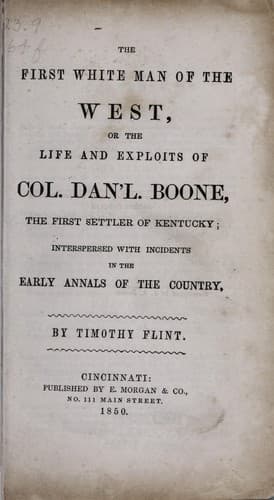
The First White Man of the West: Life and Exploits of Col. Dan'l. Boone, the First Settler of Kentucky;; Interspersed with Incidents in the Early Annals of the Country.Flint, Timothy
History
The First White Man of the West: Life and Exploits of Col. Dan'l. Boone, the First Settler of Kentucky;; Interspersed with Incidents in the Early Annals of the Country.
But, in a higher sphere, and in the service of his country, he united
the instinctive tact and dexterity of a huntsman with the bravery of a
soldier. No labor was too severe for his hardihood; no enterprise too
daring and forlorn for his adventure; no course too intricate and
complicated for his judgment, so far as native talent could guide it. As
a Colonel of the militia, he conducted expeditions against the Indians
with uncommon success. After the country had become populous, and he a
husband and a father, in the midst of an affectionate family, possessed
of every comfort--such was the effect of temperament, operating upon
habit, that he became often silent and thoughtful in the midst of the
social circle, and was seen in that frame to wander away into remote
forests, and to bury himself amidst the unpeopled knobs, where, in a few
weeks, he would reacquire his cheerfulness. In one of these excursions
he disappeared, and was seen no more, leaving no trace to determine
whether he died a natural death, was slain by wild beasts, or the
tomahawk of the savage.
Among the names of many of the first settlers of Harrodsburgh, are those
that are found most prominent in the early annals of Kentucky. In the
first list of these we find the names of McGary, Harland, McBride, and
Chaplain. Among the young settlers, none were more conspicuous for
active, daring, and meritorious service, than James Ray. Prompt at his
post at the first moment of alarm, brave in the field, fearless and
persevering in the pursuit of the enemy, scarcely a battle, skirmish, or
expedition took place in which he had not a distinguished part. Equally
expert as a woodsman, and skilful and successful as a hunter, he was
often employed as a spy. It is recorded of him that he left his
garrison, when short of provisions, by night marched to a forest at the
distance of six miles, killed a buffalo, and, loaded with the choice
parts of the flesh, returned to regale the hungry inhabitants in the
morning. He achieved this enterprise, too, when it was well known that
the vicinity was thronged with Indians, lurking for an opportunity to
kill. These are the positions which try the daring and skill, the
usefulness and value of men, furnishing a criterion which cannot be
counterfeited between reality and resemblance.
Public-domain text, read in full here on John Shaqi.
Reviews
Reviews
No reviews yet
Be the first to share your thoughts on this work.
Elsewhere in the archive
Join the Discussion
Join the discussion
Sign in to leave a comment or review.
Sign InorCreate an account