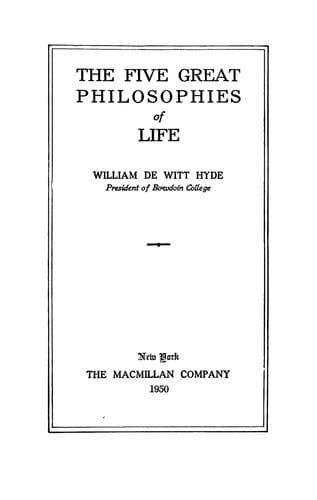
The Five Great Philosophies of LifeHyde, William De Witt
Philosophy
The Five Great Philosophies of Life
Hyde, William De Witt
Ethics; Philosophy, Ancient
The brave man does not like criticism, unpopularity, defeat, hostility,
any better than anybody else. He does not pretend to like them. He does
not court them. He does not pose as a martyr every chance that he can
get. He simply takes these pains and ills as under the circumstances the
best means of furthering the ends he has at heart. For their sake he
swallows criticism and calls it good; invites opposition and glories in
overcoming it, or being overcome by it, as the fates may decree; accepts
persecution and rejoices to be counted worthy to suffer in so good a
cause.
It is all a question here as everywhere in Aristotle of the ends at
which one aims, and the sense of proportion with which he chooses his
means. In his own words: "The man, then, who governs his fear and
likewise his confidence aright, facing dangers it is right to face, and
for the right cause, in the right manner, and at the right time, is
courageous. For the courageous man regulates both his feelings and his
actions with due regard to the circumstances and as reason and
proportion suggest. The courageous man, therefore, faces danger and does
the courageous thing because it is a fine thing to do." As Muirhead sums
up Aristotle's teaching on this point: "True courage must be for a noble
object. Here, as in all excellence, action and object, consequence and
motive, are inseparable. Unless the action is inspired by a noble
motive, and permeated throughout its whole structure by a noble
character, it has no claim to the name of courage."
The virtues cannot be learned out of a book, or picked up ready-made.
They must be acquired, by practice, as is the case with the arts; and
they are not really ours until they have become so habitual as to be
practically automatic. The sign and seal of the complete acquisition of
any virtue is the pleasure we take in it. Such pleasure once gained
becomes one's lasting and inalienable possession.
Public-domain text, read in full here on John Shaqi.
Reviews
Reviews
No reviews yet
Be the first to share your thoughts on this work.
Elsewhere in the archive
Join the Discussion
Join the discussion
Sign in to leave a comment or review.
Sign InorCreate an account