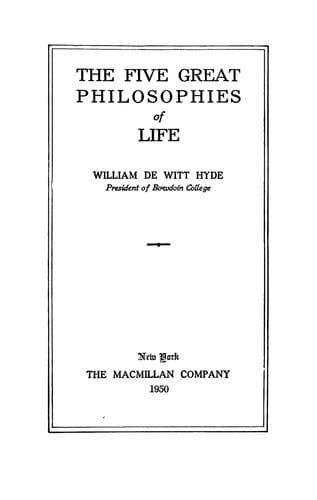
The Five Great Philosophies of LifeHyde, William De Witt
Philosophy
The Five Great Philosophies of Life
Hyde, William De Witt
Ethics; Philosophy, Ancient
"Judge not that ye be not judged. For with what judgement ye judge, ye
shall be judged, and with what measure ye mete, it shall be measured
unto you. And why beholdest thou the mote that is in thy brother's eye,
but considerest not the beam that is in thine own eye? Or how wilt thou
say to thy brother, Let me cast out the mote out of thine eye, and lo,
the beam is in thine own eye? Thou hypocrite, cast out first the beam
out of thine own eye, and then shalt thou see clearly to cast out the
mote out of thy brother's eye."
Love will waste no time trying to explain itself to the selfish. If Love
does not commend itself by its own light and warmth to a man, no forms
of words can make him understand it. The sensual, the greedy, the hard,
and the cruel Love will treat as gently and kindly as circumstances
permit; yet expect as a matter of course that they will interpret Love's
justice as hardness, kindness as weakness, temperance as asceticism,
forbearance as cowardice, sacrifice as stupidity. Those who love will
not mind being misunderstood by those who do not; knowing that any
attempted explanation would only increase their conceit and hardness of
heart, and so make a bad matter worse.
"Give not that which is holy unto the dogs, neither cast your pearls
before the swine, lest haply they trample them under their feet, and
turn and rend you."
Since Love is "the greatest thing in the world," we are bound to stand
ready with girt loins, and trimmed, burning lamps, to shed its light far
and wide. To cover it up would be to deprive ourselves and our fellows
of the one sight in all the world best worth seeing, and so to hinder
its spread. False modesty that would keep Love's good works out of sight
is as bad as false pride that would thrust oneself forward. Though works
done merely to be seen are not good at all, yet good works genuinely
done for Love's sake gain added influence and lustre when frankly and
freely allowed to be seen as the beautiful things that they are. The
Christian is under spiritual compulsion to be a missionary. Other
systems draw their little circles of disciples about them, as Jesus
drew His twelve. One cannot hold what he believes to be a true and
helpful view of life without wishing to communicate it to others. Yet
this tendency, which is natural to every principle, is characteristic of
Christianity in a unique degree. For the Christian Spirit consists in
Love, the desire to give to others the best one has. And what can be so
good, so desirable to impart, as this very Spirit of Love, which is
Christianity itself? That is why the Christian must, in some form or
other,--by journeying to foreign lands, by contribution to missionary
work at home, by gifts to Christian education, by support of settlement
work, or perhaps best of all by the silent diffusion of a Christian
example in the neighbourhood, or the unnoticed expression of the
Christian Spirit in the home,--be a propagator of the Spirit of Love he
has himself received.
Public-domain text, read in full here on John Shaqi.
Reviews
Reviews
No reviews yet
Be the first to share your thoughts on this work.
Elsewhere in the archive
Join the Discussion
Join the discussion
Sign in to leave a comment or review.
Sign InorCreate an account