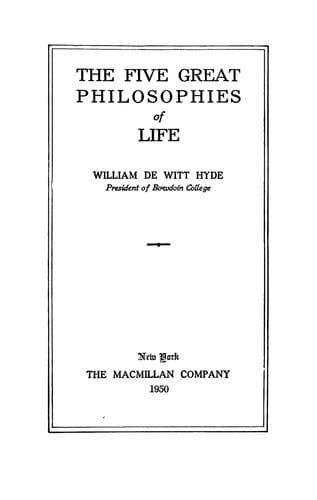
The Five Great Philosophies of LifeHyde, William De Witt
Philosophy
The Five Great Philosophies of Life
Hyde, William De Witt
Ethics; Philosophy, Ancient
Fourth: Trial brings out our best qualities, is "stuff to try the soul's
strength on," and "educe the man," as Browning puts it. This
interpretation of evil as a means of bringing out the higher moral
qualities, though not peculiar to Stoicism, was very congenial to their
system, and appears frequently in their writings. "Just as we must
understand when it is said that Æsculapius prescribed to this man horse
exercise, or bathing in cold water, or going without shoes, so we must
understand it when it is said that the nature of the universe prescribed
to this man disease, or mutilation, or loss of anything of the kind."
"Calamity is the touchstone of a brave mind, that resolves to live and
die master of itself. Adversity is the better for us all, for it is
God's mercy to show the world their errors, and that the things they
fear and covet are neither good nor evil, being the common and
promiscuous lot of good men and bad."
V
THE STOIC PARADOXES
A good test of one's appreciation of the Stoic position is whether or
not one can see the measure of truth their paradoxes contain.
The first paradox is that there are no degrees in vice. In the words of
the Stoic, "The man who is a hundred furlongs from Canopus, and the man
who is only one, are both equally not in Canopus."
One of the few bits of moral counsel which I remember from the infant
class in the Sunday-school runs as follows:--
"It is a sin
To steal a pin:
Much more to steal
A greater thing."
This, in spite of its exquisite lyrical expression, the Stoic would
flatly deny. The theft of a pin, and the defalcation of a bank cashier
for a hundred thousand dollars; a cross word to a dog, and a course of
conduct which breaks a woman's heart, are from the Stoic standpoint
precisely on a level. For it is not the consequences but the form of our
action that is the important thing. It is not how we make other people
feel as a result of our act, but how we ourselves think of it, as we
propose to do it, or after it is done, that determines its goodness or
badness. If I steal a pin, I violate the universal law just as clearly
and absolutely as though I stole the hundred thousand dollars. I can no
more look with deliberate approval on the cross word to a dog, than on
the breaking of a woman's heart. There are things that do not admit of
degrees. We must either fire our gun off or not fire it. We cannot fire
part of the charge. We want either an absolutely good egg for breakfast,
or no egg at all. One that is partially good, or on the line between
goodness and badness, we send back as altogether bad. If there is a
little round hole in a pane of glass, cut by a bullet, we reject the
whole pane as imperfect, just as though a big jagged hole had been made
in it by a brickbat. We get an echo of this paradox in the statement of
St. James, "For whosoever shall keep the whole law, and yet stumble in
one point, he is guilty of all."
Public-domain text, read in full here on John Shaqi.
Reviews
Reviews
No reviews yet
Be the first to share your thoughts on this work.
Elsewhere in the archive
Join the Discussion
Join the discussion
Sign in to leave a comment or review.
Sign InorCreate an account