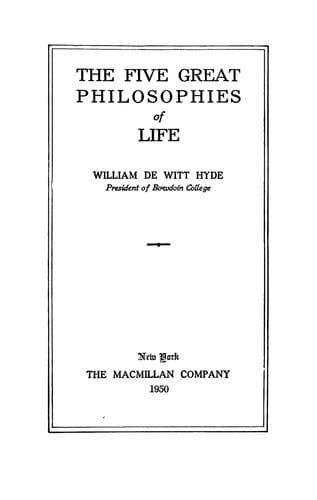
The Five Great Philosophies of LifeHyde, William De Witt
Philosophy
The Five Great Philosophies of Life
Hyde, William De Witt
Ethics; Philosophy, Ancient
Second: Since virtue or integrity is the only good, nothing but the loss
of that can be a real evil. When this is present, nothing of real value
can be lacking. A Stoic then says, "Virtue suffers no vacancy in the
place she inhabits; she fills the whole soul, takes away the
sensibility of any loss, and is herself sufficient." "As the stars hide
their diminished heads before the brightness of the sun, so pains,
afflictions, and injuries are all crushed and dissipated by the
greatness of virtue; whenever she shines, everything but what borrows
its splendour from her disappears, and all manner of annoyances have no
more effect upon her than a shower of rain upon the sea." "It does not
matter what you bear, but how you bear it." "Where a man can live at
all, he can live well." "I must die. Must I then die lamenting? I must
go into exile. Does any man hinder me from going with smiles and
cheerfulness and contentment?" "Life itself is neither good nor evil,
but only a place for good and evil." "It is the edge and temper of the
blade that make a good sword, not the richness of the scabbard; and so
it is not money and possessions that make a man considerable, but his
virtue." "They are amusing fellows who are proud of things which are not
in our power. A man says: I am better than you for I possess much land,
and you are wasting with hunger. Another says: I am of consular rank;
another: I have curly hair. But a horse does not say to a horse: I am
superior to you, for I possess much fodder and much barley, and my bits
are of gold, and my harness is embroidered; but he says: I am swifter
than you. And every animal is better or worse from his own merit or his
own badness. Is there then no virtue in man only, and must we look to
our hair, and our clothes, and to our ancestors?" "Let our riches
consist in coveting nothing, and our peace in fearing nothing."
Third: What seems evil to the individual is good for the whole: and
since we are members of the whole is good for us. "Must my leg be
lamed?" the Stoic asks. "Wretch, do you then on account of one poor leg
find fault with the world? Wilt thou not willingly surrender it for the
whole? Know you not how small a part you are compared with the whole?"
"If a good man had foreknowledge of what would happen, he would
coöperate toward his own sickness and death and mutilation, since he
knows that these things are assigned to him according to the universal
arrangement, and that the whole is superior to the part."
Public-domain text, read in full here on John Shaqi.
Reviews
Reviews
No reviews yet
Be the first to share your thoughts on this work.
Elsewhere in the archive
Join the Discussion
Join the discussion
Sign in to leave a comment or review.
Sign InorCreate an account