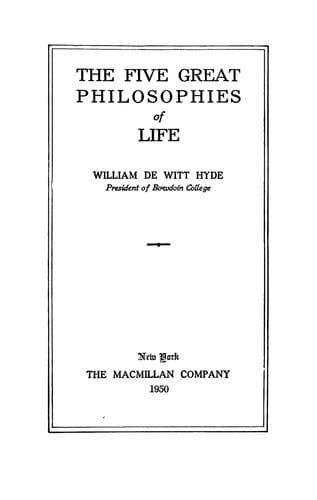
The Five Great Philosophies of LifeHyde, William De Witt
Philosophy
The Five Great Philosophies of Life
Hyde, William De Witt
Ethics; Philosophy, Ancient
pronounce it good. The wise man will bear pain up to a certain point;
and when he reaches that limit, he will stop. What is the point? Where
is the limit? Virtue is the point up to which the bearing of pain is
good, the limit beyond which the bearing of pain becomes an evil.
Virtue, then, is the supreme good, and makes everything that furthers
it, whether pleasurable or painful, good. Virtue makes everything that
hinders it, whether pleasurable or painful, bad. What, then, is virtue?
In what does this priceless pearl consist? We have our two analogies.
Virtue is to pleasure what the music is to the tuning of the instrument.
Just as the perfection of the music proves the excellence of the tuning,
so the perfection of virtue justifies the particular pleasures we enjoy.
Virtue stands related to the endurance of pain, as health stands related
to the taking of medicine. The perfection of health proves that, however
distasteful the medicine may be, it is nevertheless good; and any
imperfection of health that may result from either too much or too
little medicine shows that in the quantity taken the medicine was bad
for us. Precisely so pain is good for us up to the point where virtue
requires it. Below or above that point, pain becomes an evil.
Plato spared no pains to disentangle the question of virtue from its
complications with rewards and penalties, pleasures and pains. As the
virtue of a violin is not in its carving or polish, but in the music it
produces; as the virtue of medicine is not in its sweetness or its
absence of bitterness, so the virtue of man has primarily nothing to do
with rewards and penalties, pleasures or pains. In our study of virtue,
he says, we must strip it naked of all rewards, honours, and emoluments;
indeed we must go farther and even dress it up in the outer habiliments
of vice; we must make the virtuous man poor, persecuted, forsaken,
unpopular, distrusted, reviled, and condemned. Then we may be able to
see what there is in virtue which, in every conceivable circumstance,
makes it superior to vice. He makes one of his characters in the
Republic complain that: "No one has ever adequately described either in
verse or prose the true essential nature of either righteousness or
unrighteousness immanent in the soul, and invisible to any human or
divine eye; or shown that of all the things of a man's soul which he has
within him, righteousness is the greatest good, and unrighteousness the
greatest evil. Therefore I say, not only prove to us that righteousness
is better than unrighteousness, but show what either of them do to the
possessors of them, which makes the one to be good and the other evil,
whether seen or unseen by gods and men." Accordingly he attributes to
the unrighteous man skill to win a reputation for righteousness, even
while acting most unrighteously. He clothes him with power and glory,
and fame, and family, and influence; fills his life with delights;
Public-domain text, read in full here on John Shaqi.
Reviews
Reviews
No reviews yet
Be the first to share your thoughts on this work.
Elsewhere in the archive
Join the Discussion
Join the discussion
Sign in to leave a comment or review.
Sign InorCreate an account