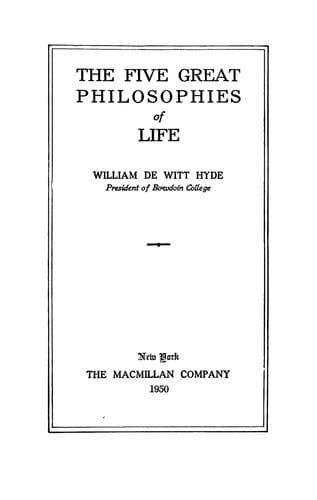
The Five Great Philosophies of LifeHyde, William De Witt
Philosophy
The Five Great Philosophies of Life
Hyde, William De Witt
Ethics; Philosophy, Ancient
We have now seen what righteousness is, whether in a state or in an
individual. It is the health, harmony, beauty, excellence of the whole
state or the whole man, secured by having each member attend strictly to
its own distinctive work, with a view to the good of the whole state or
the whole man. Thus defined it is something so obviously desirable and
essential, that nothing else is worthy to be compared with it. Whoever
parts with it even in exchange for the greatest outward honours,
emoluments, comforts, or pleasures, is bound to get the worst of the
bargain. Yet men do part with it; states do part with it. And the eighth
and ninth books of the Republic are devoted to a description of the four
stages of degeneration through which states and individuals pass on the
downward road from righteousness and virtue to unrighteousness and vice.
The breaking up of a thing often reveals its nature as effectually as
the putting it together; and as we have traced the four virtues by which
either the state or the soul is constructed, it will throw added light
upon the problem to trace in conclusion the four stages through which
men and states go down to destruction.
VI
THE STAGES OF DEGENERATION
The first step down is where, instead of the good, men seek personal
honour and distinction. At first the deterioration, whether in state or
individual, is hardly noticeable. An ambitious statesman, on the whole,
will advocate, if he is shrewd and far-sighted, much the same measures
as the statesman who is intent on the welfare of the state. For he knows
that by promoting the public welfare he will most effectively gain the
reputation and distinction he desires. Yet there is a marked difference
in the attitude of mind, and in the long run that difference will
express itself in action. When it comes to a close and hard decision,
where the real interest of the state lies in one direction, and the
waves of popular enthusiasm are running in an opposite direction, the
man who cares for the real welfare of the state will stand fast, while
the man who cares supremely for honour and distinction will be more
likely to give way. Besides, contention and strife will arise, since the
ambitious man is more anxious to do something himself than he is to have
the best thing done by some one else. Hence the state where the
statesmen love power, office, and honour will be less well off than the
state where they are disinterestedly devoted to the public good.
Public-domain text, read in full here on John Shaqi.
Reviews
Reviews
No reviews yet
Be the first to share your thoughts on this work.
Elsewhere in the archive
Join the Discussion
Join the discussion
Sign in to leave a comment or review.
Sign InorCreate an account