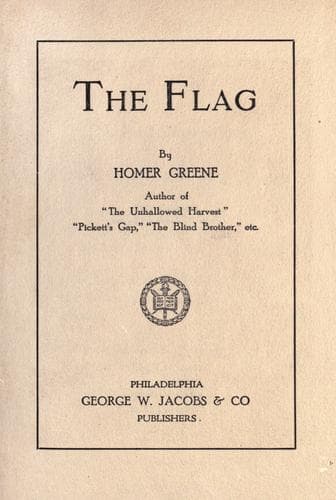
Patriotism -- Juvenile fiction; World War, 1914-1918 -- Juvenile fiction
Aleck did not at first recognize him, but a moment later, seeing who
it was that had stopped to help him, he reached up a trembling hand
and laid it on his friend's face. Something in his mouth or throat had
gone wrong and he could not speak.
After exhausting his comrade's emergency kit and his own in first aid
treatment of the wounds, Pen called for assistance to a soldier who
was staggering by, and between them, across the torn field with its
crimson and ghastly fruitage, with fragments of shrapnel hurtling
above them, and with bodies of soldiers, dead and living, tossed into
the murky air by constantly exploding shells, they half carried, half
dragged the wounded man across the ravine and up the hill to a
captured German trench, and turned him over to the stretcher-bearers
to be taken to the ambulances.
It was after this day's fighting that Pen, "for conspicuous bravery in
action," was promoted to the rank of sergeant. He wore his honor
modestly. It gave him, perhaps, a better opportunity to do good work
for Britain and for France, and to rehabilitate himself in the eyes of
his own countrymen; otherwise it did not matter.
So the fighting on the Somme went on day after day, week after week,
persistent, desperate, bloody. It was early in August, after the
terrific battle by which the whole of Delville Wood passed into
British control, that Pen's battalion was relieved and sent far to the
rear for a long rest. Even unwounded men cannot stand the strain of
continuous battle for many weeks at a stretch. The nervous system,
delicate and complicated, must have relief, or the physical
organization will collapse, or the mind give way, or both.
At the end of the first night's march from the front the battalion
camped in the streets of a little, half-wrecked village on the banks
of the Avre. Up on the hillside was a long, rambling building which
had once been a convent but was now a hospital. Pen knew that
somewhere in a hospital back of the Somme Aleck was still lying, too
ill to be moved farther to the rear. It occurred to him that he might
find him here. So, in the hazy moonlight of the August evening, having
obtained the necessary leave, he set out to make inquiry. He passed up
the winding walk, under a canopy of fine old trees, and reached the
entrance to the building. From the porch, looking to the north, toward
the valley of the Somme, he could see on the horizon the dull gleam of
red that marked the battle line, and he could hear the faint
reverberations of the big guns that told of the fighting still in
progress. But here it was very quiet, very peaceful, very beautiful.
For the first time since his entrance into the great struggle he
longed for an end of the strife, and a return to the calm, sweet,
lovely things of life. But he did not permit this mood to remain long
with him. He knew that the war must go on until the spirit that
launched it was subdued and crushed, and that he must go with it to
whatever end God might will.
Public-domain text, read in full here on John Shaqi.
Reviews
Reviews
No reviews yet
Be the first to share your thoughts on this work.
Elsewhere in the archive
Join the Discussion
Join the discussion
Sign in to leave a comment or review.
Sign InorCreate an account