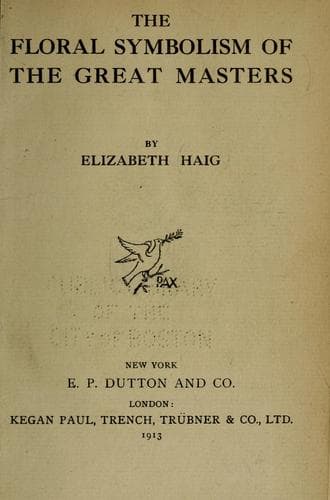
The floral symbolism of the great mastersHaig, Elizabeth
Religion
The floral symbolism of the great masters
Haig, Elizabeth
Flowers -- Symbolic aspects
The device upon the banner was dictated to her by her patron saints,
Margaret and Catharine. It was of white linen, fringed with silk, and
embroidered with a figure of the Saviour holding a globe in His hands,
while an angel knelt on either side in adoration. _Jhesus Maria_ was
inscribed at the foot. A repetition of this banner recopied from age to
age is said to be preserved at Tours.
XIV
THE LILY OF THE ANNUNCIATION
There is one incident in the life of the Virgin Mary which is
particularly associated with lilies. It is the Annunciation.
The Annunciation was not often depicted before the twelfth
century, though there are instances of it on some early ivories,
on a sarcophagus at Ravenna of the fifth century, in the famous
sixth-century Syrian MS. of the Laurentian Library,[187] and among the
mosaics of Santa Maria Maggiore.[188] During the twelfth and thirteenth
centuries, while the veneration of the Virgin within the Catholic
Church steadily grew greater, the story of her life, as apart from
that of her Divine Son, appeared in sculpture and stained glass, but
still the Annunciation was a comparatively rare subject and simply
treated. Early in the fourteenth century, however, a whole flight of
announcing angels settled down over Italy, some drifting as far north
as Holland. We find them kneeling, standing, just alighting, often with
the wind of swift movement still in their garments and almost always on
the left hand of the picture, with the Virgin in the place of honour
on the right. The Annunciation, the announcing of the near approach
of ‘the dayspring from on high,’ which was to bring light and joy and
freedom to a world groping in the twilight of an imperfect revelation,
was an incident which particularly appealed to minds rejoicing in the
intellectual liberation of the Renaissance. It appealed, too, to the
joyous nature of the Florentines, who hated the sad and tragic aspects
of life, loving fresh and spring-like things and rather elaborate
simplicity. Pictures of the Annunciation multiplied, particularly
in Florence, which was just then evolving the school which was to
influence so powerfully the Western world’s pictorial conceptions of
the divine mysteries. And in the great majority of Annunciations we
find lilies, for in this incident of the Virgin’s life above all others
it was necessary to emphasize the purity which made the wonder of the
angel’s salutation.
Public-domain text, read in full here on John Shaqi.
Reviews
Reviews
No reviews yet
Be the first to share your thoughts on this work.
Elsewhere in the archive
Join the Discussion
Join the discussion
Sign in to leave a comment or review.
Sign InorCreate an account