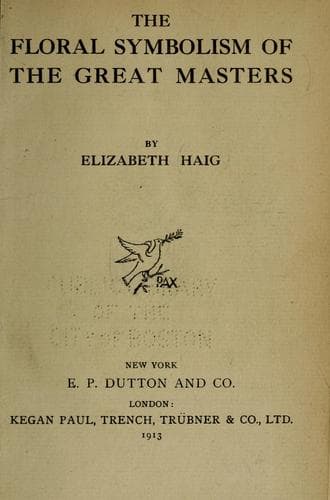
The floral symbolism of the great mastersHaig, Elizabeth
Religion
The floral symbolism of the great masters
Haig, Elizabeth
Flowers -- Symbolic aspects
On the other hand it may be possible that the painters of Florence
in the fifteenth century had harked back to another source for their
symbolism and had taken the imagery of Saint Gregory the Great, who
used the pomegranate as the emblem of the Christian Church ‘because
of the inner unity of countless seeds in one and the same fruit.’ But
in later Italian art, as in all the Northern countries and in modern
Church symbolism, the fruit, most usually the apple, which is in the
hand of the Infant Christ, is the fruit of redemption, as the apple of
Adam was the fruit of damnation.
Following the same analogy, the Virgin is regarded as the second Eve,
the second universal mother, who, through her Son, is to repair the
fault of the first.
The symbolists of the thirteenth century found what they considered
proof of this in the word of Scripture.
Conrad von Würztburg writes:
‘Let a man take three letters:
When these straightforward are read,
The little word “Ave” stands out,
The new word of salutation (or healing).
Let him begin at the end,
And read to the beginning,
And “Eva” is found written.
* * * * *
That one may thereby know,
It is thou who fulfillest,
The old and the new Covenants.
The greeting from the angel’s mouth
Greeting thee, O royal spotless maid,
Hath told me this.’[312]
Therefore the apple, which masters of the Flemish and early German
schools sometimes introduced into Annunciations, laying it, for
instance, upon the window-sill, is the apple of redemption.
The apple in the hand of Eve is always the apple of damnation. There is
a curious drawing by Martin Schöngauer of the ‘Descent into Hell.’ Adam
and Eve come forth first of the released souls, Eve holding the apple,
which has the marks of her teeth still upon it.
In the hand of Mary it is again the apple of redemption, but it is the
fruit of the Fall when it is between the jaws of the serpent or dragon,
which she, at her Assumption, treads under foot.
[Illustration:
_Martin Schöngauer_
ADAM AND EVE DELIVERED FROM HELL
(Print Room, Alte Pinakothek, Munich)]
In Italian art the apple is less often found in the Madonna pictures,
but the ancient analogy was not forgotten. On the predella of Lorenzo
di Credi’s ‘Annunciation’[313] there are three exquisite little scenes
from the life of Eve, and Vasari introduces the Tree of the Knowledge
of Good and Evil into his ‘Conception of the Virgin,’ painted in 1540.
Vasari describes it himself:
Public-domain text, read in full here on John Shaqi.
Reviews
Reviews
No reviews yet
Be the first to share your thoughts on this work.
Elsewhere in the archive
Join the Discussion
Join the discussion
Sign in to leave a comment or review.
Sign InorCreate an account