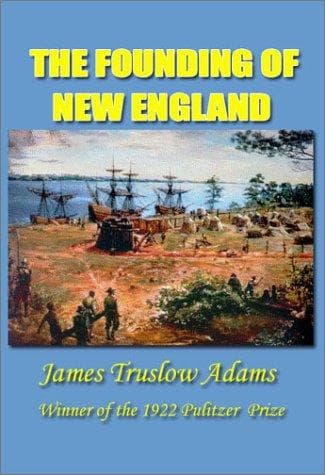
New England -- History -- Colonial period, ca. 1600-1775
By her policy of annexation, Massachusetts had added over forty thousand
square miles to her territory; while by that of nullification, she had
patently shown that the bonds uniting the New England Confederacy were
but ropes of sand. Confederation was a failure and imperial control as
yet impossible. The unification of New England was progressing rapidly,
but it was a mere process of absorption by Massachusetts. Had there been
no hindrance offered by England to the movement, the fate of the other
colonies was amply foreshadowed. A single state, with its capital at
Boston, guided by the reactionary ideas of its leaders, would probably
have arisen, and much of the work already accomplished for the
enfranchisement of the individual by Connecticut and Rhode Island, as
well as the progress so far made by Massachusetts herself, might have
been lost.
Although her policy had met with so little real resistance in the north,
it received an unexpected check in the south, from the despised Rhode
Islanders, while the restoration of the monarchy in England was
permanently to save the independence of that colony and of Connecticut.
In view of the circumstances, that event, and the assertion of imperial
control which followed it, cannot be considered as so inimical to the
interests of liberty and the colonies as writers whose attention and
sympathy have been wholly devoted to Massachusetts have usually pictured
it. In spite of the many fine qualities of the Bay Colony, and the
services which she rendered in the settlement of New England, it was
fortunate that her career of aggrandizement was halted, for the United
States could ill afford to have lost the independent contributions made
to her intellectual and political life by the smaller colonies. Indeed,
it may even be questioned, if a single powerful, unscrupulous, and
aggressive state had come to occupy the whole of New England, and
possibly the Hudson Valley, whether the United States, as a federal
nation in its present form, would have come into existence at all. When
one considers the possibilities involved in a wholly different balance
of power among the colonies in the following century, the early career
of Massachusetts and the checks it encountered take on a larger
interest.
Public-domain text, read in full here on John Shaqi.
Reviews
Reviews
No reviews yet
Be the first to share your thoughts on this work.
Elsewhere in the archive
Join the Discussion
Join the discussion
Sign in to leave a comment or review.
Sign InorCreate an account