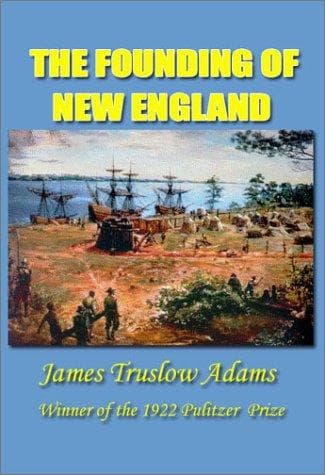
New England -- History -- Colonial period, ca. 1600-1775
They were not even, primarily, independent states in the making. The
fact that a few of them, which happened to have a continent at their
back and unlimited room for expansion, revolted after a century and a
half, has tended to obscure their real contemporary relation to England,
much as the refraction of water alters the apparent position of objects
under it when seen from an angle. The angle from which we Americans
always look at the original colonies is that of our present independent
nation; but by doing so we unwittingly shift their position from
integral parts of a complicated imperial system to incipient independent
commonwealths, assumed to have been unjustly held in thraldom. Needless
to say, such a viewpoint vitiates our appraisal of every contemporary
act and opinion. It is possible that after some hundreds of years the
present United States may be divided into two or more nations; but
to-day they form one system, and no one would think of interpreting the
present relations between North and South, or East and West, in the
light of a possible separation centuries hence. In the same way, the
relations between England and her colonies in the seventeenth century
should be interpreted in the light of their then actual and prospective
union and the political theories current, and not in that of a
subsequent, and more or less accidental, separation, and of the wholly
different theories of a later age.[714]
Footnote 714:
I speak of the separation as accidental, not because the forces then
at work did not make it almost inevitable, but because altered
economic theories and scientific discoveries, the latter largely
eliminating the extremely important elements, in the original problem,
of time and distance, occurred a half-century after the separation
took place. Had they occurred sooner, they might have prevented it, as
they have been largely instrumental in holding the remainder of the
empire together and greatly adding to it. The influence of free-trade,
steam, and electricity has been of vast importance in imperial
politics.
Public-domain text, read in full here on John Shaqi.
Reviews
Reviews
No reviews yet
Be the first to share your thoughts on this work.
Elsewhere in the archive
Join the Discussion
Join the discussion
Sign in to leave a comment or review.
Sign InorCreate an account