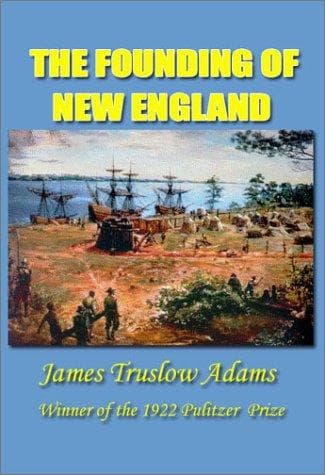
New England -- History -- Colonial period, ca. 1600-1775
The Mayflower, having been detained by the sickness of her crew, as well
as by that prevailing on shore, until the middle of April, had then
sailed for home, none of the planters abandoning the enterprise to sail
with her. Needless to say, there had been no opportunity to gather cargo
to send to the merchants in England before her sailing. With the summer,
however, health had returned, and there had been a moderate degree of
comfort, as well as abundance of food, at Plymouth; so that in
September, under the guidance of Squanto, the Pilgrims undertook their
first trading voyage, sailing to Massachusetts Bay. Their plan had been
both to explore the country and to make peace with the Indians of that
district, as well as to “procure their truck.” Although gone only four
days, the little party of thirteen, under command of Standish, were
eminently successful in all three objects, making the first beginning,
on any large scale, of that trade which was to prove their financial
salvation. In fact the Bible and the beaver were the two mainstays of
the young colony. The former saved its morale, and the latter paid its
bills; and the rodent's share was a large one. The original foundations
of New York, New England, and Canada all rest on the Indian trade, in
which the item of beaver-skins was by far the most important and
lucrative.
Having thus got together a good store of pelts and some clapboards, they
were able to despatch the Fortune, which had arrived in November, back
to England within a fortnight after her arrival, with their first
consignment, worth £500, all of which was lost to them by the capture of
the ship by the French.[233] A long letter from Weston, brought from
England by Cushman, complained bitterly and unreasonably of their having
returned no cargo in the Mayflower, and also brought word that a new
patent had been obtained for them from the Council of New England, in
the name of John Pierce and his associates.[234]
Footnote 233:
Bradford, _Plymouth_, pp. 105 _ff._; Young, _Chronicles_, pp. 234
_ff._
Footnote 234:
_Mass. Hist. Soc. Coll._, Series IV, vol. II, pp. 158 _ff._
There had also arrived on the Fortune thirty-five persons to remain in
the colony, evidently sent by the merchants, and with practically no
supplies of any kind. They were made welcome by the Pilgrims, who were
ever hospitable, not alone to those who differed from them in doctrine,
but even to their avowed enemies, so long as either needed their help.
Bradford noted that they were glad of this addition to their strength,
though he “wished that many of them had been of better condition, and
all of them better furnished with provisions.” The colonists, who had
but recently been congratulating themselves on having ample food for the
coming winter, due to their own efforts, had now to be put on very short
commons; and it was not until the gathering of the crops in the autumn
of the following year that they again had a sufficient supply.
Public-domain text, read in full here on John Shaqi.
Reviews
Reviews
No reviews yet
Be the first to share your thoughts on this work.
Elsewhere in the archive
Join the Discussion
Join the discussion
Sign in to leave a comment or review.
Sign InorCreate an account