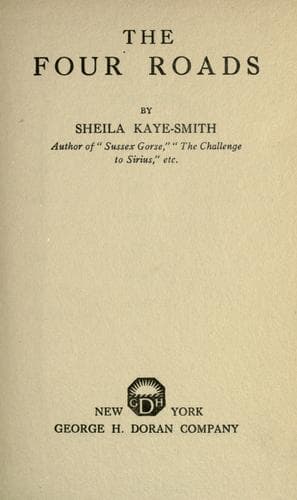
Sussex (England) -- Fiction; World War, 1914-1918 -- England -- Fiction
The little mare spanked quickly over the way on her new-shod hoofs.
Through Soul Street and Horeham Flat, by Badbrooks and Coarse Horn on
the lip of the Marsh rolled the trap, with the minister nearly silent
and the farmer talking about the War—till the oasts of Adam’s Hole
showed their red turrets against a wood, and, declining an invitation
to step in and hear half a dozen more good reasons why the Germans
would never get the Channel Ports, Mr. Sumption tramped off to where
the East Road swung into the flats.
The sun was now low, and the sunk light touched the moon, so that
her smudged arc kindled and shone out of the cold dimness. Red and
yellow gleams wavered over the country of the Four Roads, sweeping
up the meadows towards Three Cups Corner, and lighting the woods
that blotched the chimneys of Brownbread Street. He saw Sunday
Street slitting the hill with a red gape, and the sheen of the ponds
by Puddledock, and the flare of gorse and broom on Magham Down.
There was a great clearness and cleanness in the watery air, so that
he could see the roofs of farmsteads far away and little cottages
standing alone like toadstools in the fields. Sounds came clearly,
too—there was a great clucking on all the farms, and the lowing of
cows; now and then the bark of a dog came sharply from a great way
off, sheep called their lambs in the meadows by Harebeating, and a
boy was singing reedily at Cowlease Farm....
It was all very still, very lovely, steeped through with the spirit
of peace—not even the beat of the guns could be heard to-night. These
were the fields for which the boys in France had died, the farms and
lanes they had sealed in the possession of their ancient peace by a
covenant signed in blood. As Mr. Sumption looked round him at the
country slowly sinking into the twilight, a little of its quiet crept
into his heart. These were the fields for which the boys had died.
They had not died for England—what did they know of England and the
British Empire? They had died for a little corner of ground which was
England to them, and the sprinkling of poor common folk who lived in
it. Before their dying eyes had risen not the vision of England’s
glory, but just these fields he looked on now, with the ponds, and
the woods, and the red roofs ... and the women and children and old
people who lived among them—the very same whom last night he had
scolded and cursed, told they were scarce worth preaching at. For the
first time he felt ashamed of that affair. He might not think them
worth preaching at, but other men, and better men, had found them
worth dying for.
Public-domain text, read in full here on John Shaqi.
Reviews
Reviews
No reviews yet
Be the first to share your thoughts on this work.
Elsewhere in the archive
Join the Discussion
Join the discussion
Sign in to leave a comment or review.
Sign InorCreate an account