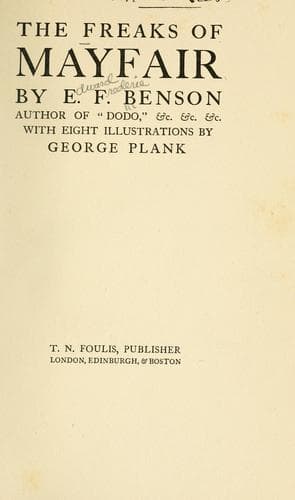
The Freaks of MayfairBenson, E. F. (Edward Frederic)
General
The Freaks of Mayfair
Benson, E. F. (Edward Frederic)
England -- Social life and customs -- 20th century -- Fiction; Humorous stories, English; Short stories, English
This literary profession of his is no mere matter of a parish-magazine,
or of letters to the _Guardian_ about the Eastward position, or the
_Spectator_ about early buttercups, but he publishes on his own account
at least two volumes every year. Usually those take the form of essays,
written in the second or pair-of-wooden-shoes manner, and probably each
of them contains a greater number of true and edifying reflections than
have ever before appeared between the covers of a single volume. It is
no disparagement of them to say that they seem to go on for ever, for so
do the waters of a spring, except in times of such severe drought as is
unknown to the pen of this ready writer. They all begin in an enticing
manner, for Mr. Sandow tells you how he was walking across the Park one
morning, when he observed two sparrows quarrelling over a piece of bread
that some kind bystander had thrown them. This naturally gives rise to
reflections as to the distressing manner in which ill-temper spoils our
day. The kind bystander is, of course, Providence, who throws quantities
of bread, and Mr. Sandow tells us that it is the truer wisdom not to
behave like silly sparrows and all wrangle over one piece, but hop
cheerfully away, with a blessing, in the certainty of finding plenty
more. Or again Mr. Sandow describes how he was hurrying to the station
to catch a train, fussing himself with the thought that he would not be
in time for it, and not noticing the limpid blue of the sky and the
white clouds that floated across it. When he came to the station he
found he had still five minutes to spare and so need not have hurried at
all, but drunk in the gladness of God’s spring. From this lesson, he
humbly hopes, he will be less disposed to fuss in the future, but trust
to the wise hand that guides him. We are not told what would have been
the moral if Mr. Sandow had missed his train, but then, after all he did
not write about that, and one can only conjecture that it would have
been a lesson to him as to how to wait patiently (picking up edifying
crumbs at the station) for the next train. Or he sees a house in process
of being pulled down, with gaping wall showing the internal decoration,
and tenderly wonders what sweet private converse took place in front of
the denuded fire-place. His vivid imagination pictures charming scenes:
on one wall on the third storey was a paper with repeated images of Jack
and Jill and Red Riding Hood and Little Miss Muffit, and he conjectures
that here was the nursery, and the paper looked down on children at
play. But the children are grown up now; they have outlived their
nursery, as we all do, but instead of regretting days that are no more
we must go on from strength to strength, till we reach the imperishable
house of many mansions which nobody will ever pull down. At the end of
each of these musings written in the pair-of-wooden-shoes mode comes a
passage of this kind in the second manner, a sudden purple patch about
Public-domain text, read in full here on John Shaqi.
Reviews
Reviews
No reviews yet
Be the first to share your thoughts on this work.
Elsewhere in the archive
Join the Discussion
Join the discussion
Sign in to leave a comment or review.
Sign InorCreate an account