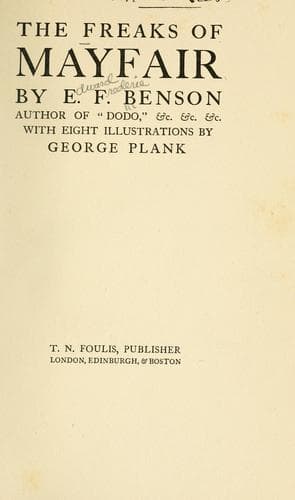
The Freaks of MayfairBenson, E. F. (Edward Frederic)
General
The Freaks of Mayfair
Benson, E. F. (Edward Frederic)
England -- Social life and customs -- 20th century -- Fiction; Humorous stories, English; Short stories, English
the cloud on Sinai, they looked down on the post-de Veres, and mumbled
together at the degeneration of that which had once been _so_ select and
is now so Verabund.
The great central Aunt Sally at which the memorio-maniacs hurl their
darts most viciously is a thing they call Smart Society, or the Smart
Set. For generations they have done so, and the poor Aunt Sally ought to
have been battered to bits long ago, for they throw their missiles
straight at her face from point-blank range. Only, by some process not
rightly understood by her assailants, she appears perfectly impervious
to their attack and proceeds on her godless way as brightly as ever. She
is also, as we shall see, largely an invention of those who so
strenuously denounce her. What started the loquacious pessimist perhaps
was that he found there were a good many nephews and nieces who enjoyed
themselves very tolerably, and began to find him and his tedious stories
about what the best people did in the age of Henry II. or Charles I. or
William IV. (according to the epoch which he remembers best) rather
tiresome, and did not listen to him with due attention. That may or may
not have set him going, but the fact that there exists in London a
quantity of rich people who like to entertain their friends (among whom
the loquacious pessimist would scorn to number himself) fills him with
ungovernable fury, and with a pen that blisters the paper, he describes
how they spend their Sunday.
Breakfast, if we may believe him, goes on from ten till twelve, lunch (a
substantial dinner) is prolonged with liqueurs and cigars till close on
tea-time, when sandwiches and even ‘bleeding woodcocks’ are provided.
Dinner is not till nine, and so late an hour finds everybody hungry
again. Then, forgetting that he has told us that eating goes on the
whole day, he informs us in another attack on poor Aunt Sally that these
same people spend Sunday in riding and driving and going out to tea ten
miles away, and careering about on a ‘troop’ of bicycles. Yet again,
forgetting that here his text is the sinful extravagance of the present
day, he informs us how stately were the good old times, when a rich man
kept as many servants as he could afford and ‘sailed along’ in a coach
and four, instead of going (as he does in these shambling, undignified
days) in the twopenny tube.... After all, the economy effected by using
the twopenny tube instead of the coach and four would enable you to buy
an occasional ‘bleeding woodcock’ for your friends, and yet not be so
extravagant as your good, stately, simple old grandfather. Or, when they
speak of modern shooting-parties these chroniclers allude to the mounds
of ‘crushed pheasants’ that are subsequently sent to be sold at the
poulterer’s, and speak of the hand-reared birds that almost perch on the
barrels of their murderers. It would be interesting to place one of
these moralists at a modern pheasant-shoot, when the birds rocket above
Public-domain text, read in full here on John Shaqi.
Reviews
Reviews
No reviews yet
Be the first to share your thoughts on this work.
Elsewhere in the archive
Join the Discussion
Join the discussion
Sign in to leave a comment or review.
Sign InorCreate an account