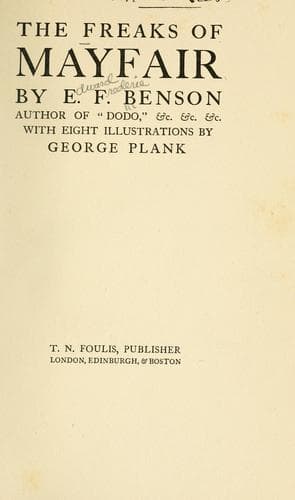
The Freaks of MayfairBenson, E. F. (Edward Frederic)
General
The Freaks of Mayfair
Benson, E. F. (Edward Frederic)
England -- Social life and customs -- 20th century -- Fiction; Humorous stories, English; Short stories, English
It is on such foundations, columned by Classy Cuttings, that the
praisers of past time build the Old Bailey, where, bewigged and berobed,
they so solemnly pronounce the extreme sentence on Smart Sets and
Society. We must not deny to their summing-up something of the
gorgeously Oriental vocabulary of Ouida, though we cannot allow them
much share in her wit. She told in the guise of fiction the sort of
thing which the praisers of past time--after consulting Classy
Cuttings--expect us to accept as facts; she and Classy Cuttings mixed
the effervescent beverage which they allow to get flat, and then label
it the beef-tea of Fact. And when we are offered these fantastic
imaginings and are assured that the lurid pictures are positively
photographic in their accuracy, all our pleasure, as readers, is gone,
and we expire with a few hollow yawns. We had hoped it was Ouida, but to
our unspeakable dismay we are told that it is all Too True. Not being
able to swallow that, we can but remember the story of Dr. Johnson and
the hot potato.
_Tempora mutantur_, and unless we change with them we shall never grasp
the true values of the marching years. Society (with a final curse on
the large S) changes, and the changes represent on the whole the opinion
of people who are on the right lines. The praisers of past time have
cried ‘Wolf’ too often with regard to the decadence they invariably
detect in the present time, and until we are more certain that at last
the wolf is really there, it is wiser to push along, than to trust in
the denunciations of those who, firmly immured in the sedan-chairs of
sixty years ago, squint through the chinks of their lowered blinds
(lowered, lest they behold vanity) at the crowd they do not know, and
the bustle that they altogether fail to understand. In their day they
kicked up their heels much higher than their grandmammas approved. They
disregarded the denunciations of their elders then, and they must not be
surprised if the younger generation, whose antics their creaking joints
and croaking minds are unable to imitate, think of them as antique and
peevish progenitors now. The arts of fifty years ago are doubtless
theirs, all except the art of gracefully retiring. Instead, the more
accomplished of them, since their loquacity no longer can hold an
audience, proceed to volumes of uncomprehending memoirs. As long as they
stick to the past, their recollections often possess an old-world
fragrance as of lavender-bags shut in disused Victorian wardrobes, but
when they come to the present the lavender-scent fades, and they reek of
brimstone and burning. A grandmamma, talking of past days, is a
delightful and adorable member of any circle, but when she laments the
dangerous speed at which trains go nowadays, every one younger than she
feels she does not quite understand. And if, getting her information
from fiction (as the praisers of past days do from the columns of Classy
Public-domain text, read in full here on John Shaqi.
Reviews
Reviews
No reviews yet
Be the first to share your thoughts on this work.
Elsewhere in the archive
Join the Discussion
Join the discussion
Sign in to leave a comment or review.
Sign InorCreate an account