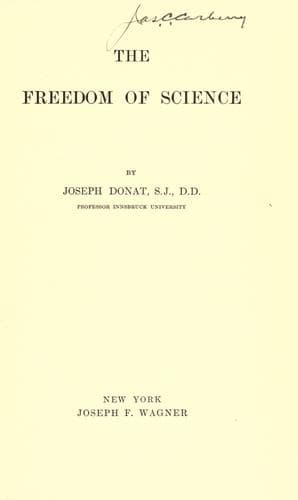
Free thought; Modernism (Christian theology) -- Catholic Church; Religion and science; Teaching, Freedom of
Let us not lose sight of the question. It cannot be denied that the man
who does not bother about faith has a greater outer freedom than the man
who does. We speak purposely of outer freedom. It is quite another
question, where real internal freedom exists, _i.e._, freedom from the
fetters of one’s own inclinations and prejudices,—in the religiously
disciplined mind, or in the other. Here we speak of inner freedom.
Obviously it is greater in the former. The deer in the forest is freer in
his movements than the cautious mountain-climber, who keeps to marked
roads and paths, so as to journey safely, yet the latter is not without
freedom. Nor will any one deny that the Australian bushman enjoys a
greater outer freedom than the civilized white, restrained by laws, by
rules and regulations, by standards of decency. And the busy writer of
many things and everything, who in his writing never pays any attention to
logic, to scientific form, to style and tact, has more freedom than one
who strictly conforms to all these.
_Every civilization, culture, and education implies restriction of
freedom_, and the more the rejection of dependence and laws increases the
nearer we approach the state of uncultured and barbarous nations. The same
applies to intellectual culture. The higher it is, the more learning and
mental culture a man has, the greater the number of truths, principles,
and intellectual standards he carries within him. By these he is bound if
he wants to advance into the higher spheres of intellectuality. And the
more the intellect rejects laws and standards the more unregulated and
dull its intellectual life will become. The more one knows the more
strictly is he bound to truth in every respect; the less one knows the
freer he is to commit errors. This is no advantage, it is the privilege of
the ignorant and untrained mind. The believer is bound by religious truth
in the same way as one who knows the truth is bound by it, while one who
is ignorant of it is not.
It is certainly not impossible for the obedience of faith to create
_intellectual conflict_. There may be cases when scientific views look
probable to the scientist, while they contradict a doctrine of faith or an
ecclesiastical decision. The roads may even cross more radically. It may
happen that his views and books are condemned, forbidden by the Church.
Public-domain text, read in full here on John Shaqi.
Reviews
Reviews
No reviews yet
Be the first to share your thoughts on this work.
Elsewhere in the archive
Join the Discussion
Join the discussion
Sign in to leave a comment or review.
Sign InorCreate an account