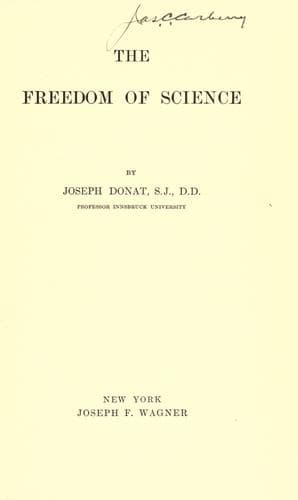
Free thought; Modernism (Christian theology) -- Catholic Church; Religion and science; Teaching, Freedom of
the date of writing of the Acts of the Apostles, as also regarding
_St. Paul’s_ attitude towards Judaism and Christian-Judaism, and
departs from the modern Protestant view (cf. pp. 28-47, 79 _seq._,
86, 93 _seq._). “Protestant authorities on church-history,” he
says elsewhere, “no longer take offence at the proposition that
the main elements of Catholicism go back to the Apostolic era, and
not only peripherically” (Theol. Literar. Zeitung, 1905, 52).
In a speech, much commented on, which he made at his university
January 12, 1907, Prof. _Harnack_, discussing the religious
question in Germany, called attention to the fact that there has
been quite a marked return to the Catholic standpoint: “From the
study of Church history we find that we all have become different
from what our fathers were, whether we may like it or not. Study
has shown that we are separated from our fathers by a long course
of development; that we do not understand their ideas and words at
all, much less do we use them in the sense they used them.” He
then draws out the comparison more particularly: “_Flacius_ and
the older Protestants denied that _Peter_ had ever been in Rome at
all. Now we know that his having been there is a fact well
evidenced in history.” The motto of the older Protestants was that
the Scriptures are the sole source of revelation. “But now, and
for a long time past, Protestant savants have realized that the
Scriptures could not be separated from tradition, and that the
collecting of the New Testament Scriptures was a part of
tradition.” “Protestants of the sixteenth century taught
justification by faith alone, without works. In the absence of
confessional controversy, no evangelical Christian would now find
fault with the teaching which declares only such faith to be of
any worth which shows itself by the love of God and of the
neighbour” (Protestantismus u. Katholizismus in Deutschland,
Preussisch. Jahrbücher 127. Bd., 1907, 301 _seq._).
Many similar instances of science confessing Erravimus in regard to the
Christian or Catholic position could be cited. They are an admonition to
be modest, not to overrate the value of a scientific proposition, and not,
with supreme confidence and infallibility, to brand it as an offence
against the human intellect to let one’s self be guided by the principles
of faith.
Moreover, it has often happened that science emphatically and sneeringly
rejected propositions, and called them false and absurd, which to-day are
considered elementary.
Public-domain text, read in full here on John Shaqi.
Reviews
Reviews
No reviews yet
Be the first to share your thoughts on this work.
Elsewhere in the archive
Join the Discussion
Join the discussion
Sign in to leave a comment or review.
Sign InorCreate an account