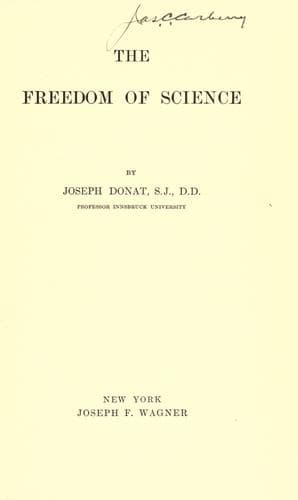
Free thought; Modernism (Christian theology) -- Catholic Church; Religion and science; Teaching, Freedom of
Is the scientist, however, to allow no presumption at all? That would be
impossible. When making his calculations the mathematician presupposes the
correctness of the multiplication table. Or is he first to prove that
twice three are six? He could not do it, because it is immediately
self-evident. In his optical experiments in the laboratory, in drawing
inferences as to the nature of light from different indications, the
physicist presupposes that senses are able to observe the facts correctly,
that everything has its respective reason, that nothing can be and not be,
at the same time, under the same conditions. Can he or must he try first
to prove it? He must presume it because it is beyond a doubt, and because
it cannot be proved at all, at least all of it cannot. The astronomer,
too, makes unhesitating use of the formulas of mathematics without
examining them anew; every natural scientist calmly presupposes the
correctness of the results established by his predecessors and goes on
building upon those results: he may do so because he cannot with reason
doubt them. Hence presumptions are common; they may be made when we are
convinced of their truth; they must be made because not everything can be
proved. Much cannot be proved because it is immediately self-evident, as,
for instance, the ability to recognize the true or the elementary
principles of reasoning; many other things cannot always be proved
minutely, because not every scientist cares to begin with the egg of Leda.
He that wants to build a house builds upon a given base; if he will not
accept it, if he desires to dig up the fundament to the very bottom, in
order to lay it anew, he will be digging forever, but the house will never
be built.
Hence to say that science must be unprepossessed cannot mean that it must
not make any presupposition. What, therefore, does it mean? Simply this:
_Science must not presume anything to be true which is false, nor anything
as proved which is still uncertain and unproved_. Whatever the scientist
knows to be certain he may take as such, presuming it as the foundation
and direction of further work; and what he knows to be probable he may
suppose to be probable.
In so doing he in no way offends against the ideal that should be
ever-present to his mind—the truth, because he merely allows himself to be
guided by the truth, recognized as such. And the sequence of truth cannot
but be truth, the sequence of certainty cannot but be certainty. But
should he presuppose to be true what is false and unproved, and the
uncertain to be certain, then he would offend against truth, against the
aim of every science.
Public-domain text, read in full here on John Shaqi.
Reviews
Reviews
No reviews yet
Be the first to share your thoughts on this work.
Elsewhere in the archive
Join the Discussion
Join the discussion
Sign in to leave a comment or review.
Sign InorCreate an account