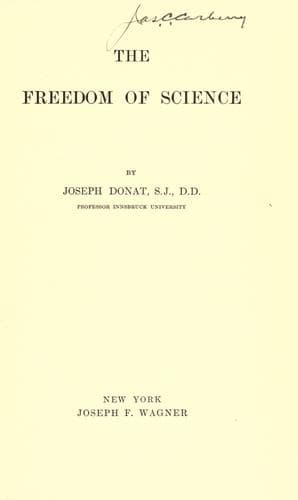
Free thought; Modernism (Christian theology) -- Catholic Church; Religion and science; Teaching, Freedom of
Many a misconception may have contributed to the definition of this
unprepossession. For instance, overlooking the important difference
between methodical doubt and serious doubt.
Then there is the erroneous opinion that we should and could proceed
everywhere in the same way as in the natural sciences. Almost parallel
with the progress in the natural sciences grew the doubt of the
correctness of the ancient physical and astronomical notion of the world;
piece after piece crumbled away under the hand of research; new truths
were discovered. In just admiration of these results it was concluded that
all provinces of human cognition should be “researched” in the same way,
not excepting religion and theories of the world; here, too, science
should cast a radical doubt upon everything and discover truth—as if here
we had to deal with matters similar to astronomy and physics, in the state
they were centuries ago; as if all mankind was still ignorant of the truth
and science had to discover it.
This right to doubt is claimed especially in the higher questions of
religion. Certain cognition by reason is, after all, impossible here, such
is the presumption, and therefore, first of all, it is the right and duty
of man, as soon as he has attained his intellectual maturity, to shape by
doubt his views of the world to the satisfaction of his mind and heart, to
win them by a struggle; nor is this true only in the case of the single
individual, but also of entire generations. To see problems everywhere,
not to have any convictions, this is taken to be true unprepossession.
“Man must learn,” so we are told, “that there is no absolute
miracle, not even in the domain of the religious life, which
supernaturally offers truth at a point or by an institution, but
that every man and every era as witnessed by the authority of
history must conquer truth by themselves for their own sake and at
their own risk” (_E. Troeltsch_, Internationale Wochensch. 1908,
26). Thus the mind of man cannot slake its thirst for positive
truth at the divine fountain of revelation, but only by search and
research. Such is the cheerful message of this science. “Amid
grave crises,” we are told again, “a new concept of science has
forced its way to the front since the beginning of the eighteenth
century and conquered the universities.” “Science is not a
finished system, but a research to be forever under examination”
(_A. Harnack_, Die Aufgabe der theol. Facultaeten, 1901, 17).
Public-domain text, read in full here on John Shaqi.
Reviews
Reviews
No reviews yet
Be the first to share your thoughts on this work.
Elsewhere in the archive
Join the Discussion
Join the discussion
Sign in to leave a comment or review.
Sign InorCreate an account