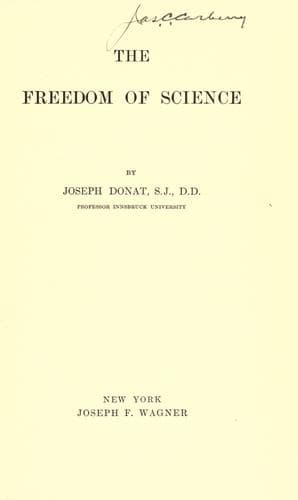
Free thought; Modernism (Christian theology) -- Catholic Church; Religion and science; Teaching, Freedom of
While no reasonable man could object to the latter,
the former is eagerly exploited against the Church (_Heiner_, Der
Syllabus, 1905, p. 31, _seq._; cf. _Frins_, Kirchenlex, 2d ed.,
XI, 1031; _Hoensbroech_, l. c. 25; _Goetz_, Der Ultramontanismus,
1905, 148).
Of course it may be taken for granted that the Syllabus is distasteful to
modern liberalism, which is branded there as one of the errors of the day.
Yet the Church cannot be censured for not becoming unfaithful to her
vocation of preserving the patrimony of Christianity to mankind, or for
acting as the invincible defender of the Christian religion in the
universal struggle between truth and error, even though the latter pose
with great assurance.
The Condemnation of Modernism.
The great excitement caused in intellectual circles by the Syllabus of
_Pius IX._ was aroused again, though not with the same intensity, when
some years ago the news of another Syllabus was circulated through the
world, and the excitement increased when the rumour was followed by the
publication of the encyclical “Pascendi Dominici gregis.” Indeed, the new
event was not very unlike the former: in the 60’s Rome’s sentence was
directed against the Modernism of that period, which called itself
liberalism. The excitement caused by its condemnation was more intense,
because it struck directly at the principles governing the liberal
politics against the Church, which principles were claimed to be the
foundation of the modern state. Now the Modernism repudiated by the
Church’s voice was nothing more than the old humanistic, fundamental,
errors of liberalism, but put in the form of a religious and philosophical
view of the world, and in Catholic garb: it meant man detached from
everything supernatural, and dependent alone on himself in his
intellectual life, more especially in his religious life.
Now, as then, similar charges were raised: The Church is the
irreconcilable foe of modern achievements and the opponent of them; “the
encyclical aims at modern intellectual life in all its phases and forms”
(XX. Jahrh., 1908, 568). Now, as then, we have the same ambiguity of the
terms “modern” and “progress.”
Public-domain text, read in full here on John Shaqi.
Reviews
Reviews
No reviews yet
Be the first to share your thoughts on this work.
Elsewhere in the archive
Join the Discussion
Join the discussion
Sign in to leave a comment or review.
Sign InorCreate an account