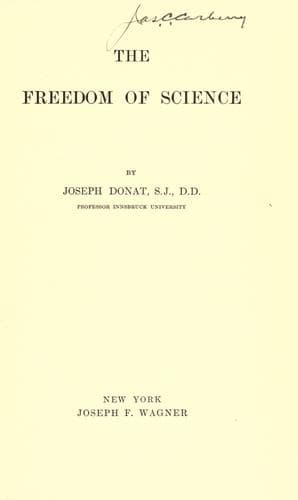
Free thought; Modernism (Christian theology) -- Catholic Church; Religion and science; Teaching, Freedom of
The previous scrutiny in general is delegated to the Bishop; all books
dealing with morals and theology must be submitted. The license to print
the book is to be given if the book is in accord with the teaching of the
Church, in so far as determined by ecclesiastical authority, the decision
based on it rests solely with the censor; if the author of the book should
fail to see that the passages objected to need revision he may try to
clear himself by stating his reasons; however, he is also free to submit
his work to another Bishop and to look for a printer in the latter’s
diocese. If one looks over the numerous books bearing the ecclesiastical
imprimatur, he will readily notice how much freedom is given, if the
author keeps within the doctrine of the Church.
The _condemnation_ of a book never strikes at the person of the author,
nor at what he has intended to express by the passages objected to;
judgment is passed only upon what is actually expressed in them. Hence it
is not necessary to give to the author himself a hearing, or a chance to
explain. The reason is that the judgment is rendered on the sense of the
passages, not on the meaning of the author. In general those books and
periodicals are forbidden which are likely to do serious damage to faith
and morals. The isolated cases of indicting the works of Catholic authors
in the nineteenth century—we may mention _Lamennais_, _Hermes_,
_Guenther_, _Loisy_, and _Schell_—show that the Church proceeds but slowly
and with consideration against the author involved.
To appreciate the Index properly, one must try to grasp without prejudice
the _purpose_ the Church has in view. This purpose is to protect the
faithful from error and from moral contagion, and to preserve the faith
intact. “What is more precious than souls, what more precious than the
faith? But both suffer damage from such reading.” Such was the judgment of
the Council of Ephesus when it drew up its book-decrees; such was the
judgment of an _Augustine_, of _Leo the Great_, and of the Holy Fathers;
such is still the judgment of the Church. Books and writings that offend
against morals are a menace to her faithful. They become infected with
wrong ideas; they are as a rule not in a position to distinguish by
themselves the false from the true, and for the most part they are not
morally strong enough to resist the allurements of error. It may also
happen that certain thoughts are true in the abstract, yet for the time
being would be a danger for many. Now, it is the right and duty of any
social authority, beginning with the head of the family and up to the
government, to protect with strong hand the precious possessions of its
subjects.
Public-domain text, read in full here on John Shaqi.
Reviews
Reviews
No reviews yet
Be the first to share your thoughts on this work.
Elsewhere in the archive
Join the Discussion
Join the discussion
Sign in to leave a comment or review.
Sign InorCreate an account