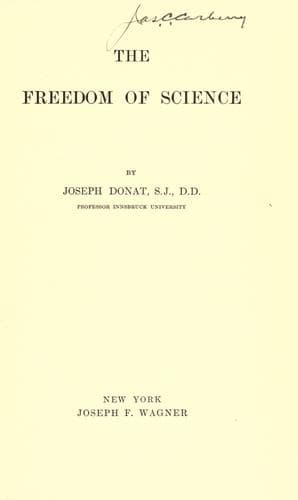
Free thought; Modernism (Christian theology) -- Catholic Church; Religion and science; Teaching, Freedom of
The Catholic scientist who appreciates the supernatural mission of his
Church will _yield to her guidance in humble confidence_, he will practise
this submission to the Church by requesting permission for reading
forbidden books, and by this spirit he will obtain God’s blessing on his
work.
In doing so he may recall to mind the edifying words of _St.
Francis of Sales_, in the preface to his treatise on the errors of
the Lutherans and Calvinists, where he gives the assurance of
having conscientiously asked for and received permission to read
their writings. “We fervently request our Catholic readers,”
writes the Saint, “not to let an evil suspicion against us arise,
as if we had read the forbidden books in spite of the prohibition
of holy Church. We are able to assure them in all truth of having
done nothing forbidden to a good Christian, and of having taken
every precaution due in a matter of so vast importance, so as not
to incur in any way the very just censures of the Church, nor in
any manner to violate the profound reverence we owe to her.” The
permission granted him, dated July 16, 1608, is still extant;
likewise one asked by _St. Charles Borromeo_.
The Catholic scientist also will readily ask the ecclesiastical Imprimatur
for certain of his works. If a careful author before publishing a work
submits the proofs to a friend of his profession, taking his comment for a
guide, why should we deem it intellectual bondage if the Catholic
scientist, in matters of faith and morals, submits his work to the formal
approval of his Church, which to him is a higher authority than any other?
and does this willingly, as in consistency with his Catholic
conviction?(5)
_Via stulti recta in oculis ejus, qui autem sapiens est audit consilia_,
says the Wise Man. It is characteristic of the fool to be wise in his own
eyes, and stubbornly to cling to his own judgment; but the prudent man
seeks advice, and suffers his attention to be called to his mistakes.
Public-domain text, read in full here on John Shaqi.
Reviews
Reviews
No reviews yet
Be the first to share your thoughts on this work.
Elsewhere in the archive
Join the Discussion
Join the discussion
Sign in to leave a comment or review.
Sign InorCreate an account