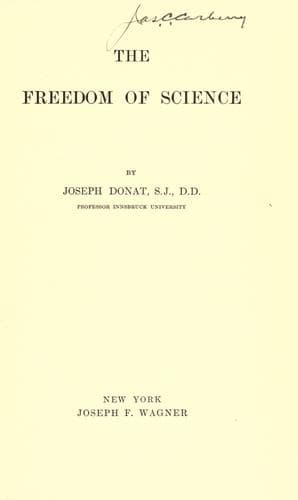
Free thought; Modernism (Christian theology) -- Catholic Church; Religion and science; Teaching, Freedom of
The real arguments for the rotation of the earth were not then
known. There were no direct proofs for the progressive revolution
of the earth around the sun. _Galileo_ advanced three main
arguments for his theory. First, he advanced the argument from the
phenomenon of the tides, which, he said, could not be accounted
for but by the rotation of the earth: an argument rejected as
futile even at that time. Next he argued from certain observations
of the spots on the sun: another worthless argument, which others,
like _Scheiner_, looked upon as proof of the older theory. The
third argument was that the new theory simplified the explanation
of certain celestial phenomena; but the scope of this argument,
valid though it was in the abstract, could not be expressed or
grasped at the time, especially since the corrections of _Tycho de
Brahe_ had removed the greatest objections to the Ptolemaic
system. The Copernican theory could not be considered certain till
the end of the seventeenth century, after _Newton’s_ work on
gravitation.
Then there were difficulties, the greatest of which was probably
the old idea of inertia, which at that time meant only that all
bodies tend to a state of rest; hence it seemed impossible that
the earth could ceaselessly execute two movements at the same
time, around the sun and around its own axis. This notion of
inertia had not been doubted in 1616; even _Kepler_ adhered to it.
Later on _Galileo_ came very near to the new idea of inertia: that
bodies tended to retain their state of repose or motion. But this
new notion, like everything else new, gained ground but slowly.
Then it was only with great difficulty that he could dispose of
the objection that were the earth to speed through space, as the
new theory claimed, the atmosphere would take a stormlike motion.
Lastly, the philosophical objection had to be met: the sun and
other celestial bodies, as far as we can know by observation, are
moving; if they do not move, then we must admit that we can know
nothing by observation.
Public-domain text, read in full here on John Shaqi.
Reviews
Reviews
No reviews yet
Be the first to share your thoughts on this work.
Elsewhere in the archive
Join the Discussion
Join the discussion
Sign in to leave a comment or review.
Sign InorCreate an account