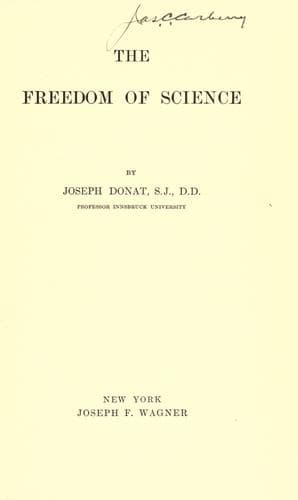
Free thought; Modernism (Christian theology) -- Catholic Church; Religion and science; Teaching, Freedom of
_Johann Kepler_, born of Protestant parents in Württemberg in 1571, was
raised a Lutheran. In 1594 he was appointed professor of mathematics at a
school in Graz, and after that he dwelt for the most time in Austria,
which country became his second home. From Graz he was called to Prague to
be mathematician at the imperial court, and from there to Linz to be
professor at the college there. His last years were passed at Sagan and
Ratisbon, where he died in 1630. Even after having left Austria he
gratefully remembered the _clementia austriaca_ and the _favor
archiducalis_. _Kepler’s_ astronomical achievements are known to
everybody, especially his laws of the planets. With an untiring spirit of
research he combined beautiful traits of character, cheerfulness,
kindness, and modesty, but chiefly a profoundly religious mind. However,
he was in difficult circumstances as far as his religious life was
concerned. Quite early he came in conflict with the religious authorities
of his confession, particularly for the reason that they considered
_Kepler’s_ Copernican views as against the Bible, a fact which the learned
astronomer could not see. There were also other differences. The conflict
became more and more aggravated. It cannot be denied that the Lutheran
Church-authorities proceeded against _Kepler_ with a lack of consideration
never shown by Rome against men like _Galileo_. _Kepler_ was expelled from
the Lutheran Church, and despite his efforts to be reinstated the ban was
never lifted.
Like _Kepler_, so was his predecessor at the Catholic court of
Prague, the Danish astronomer _Tycho Brahe_ (died 1601), a devout
Protestant, but the trials of _Kepler_ were spared him. His
erroneous idea that the Copernican system conflicted with Holy
Writ kept him from subscribing to it: it led him to devise a
system midway between _Copernicus_ and _Ptolemy_. His religious
sentiment is evidenced by a passage from a letter of his, written
at his father’s death, “Although there are many consolations for
me, of a religious nature based on Holy Writ, and of a
philosophical kind drawn from the contemplation of the fate of all
men and of the inconstancy of everything under the moon, it is a
special comfort for me that my father departed so sweetly and
piously from this valley of misery to the heavenly eternal home,
where, according to _St. Paul_, we shall find a lasting abode.”
Public-domain text, read in full here on John Shaqi.
Reviews
Reviews
No reviews yet
Be the first to share your thoughts on this work.
Elsewhere in the archive
Join the Discussion
Join the discussion
Sign in to leave a comment or review.
Sign InorCreate an account