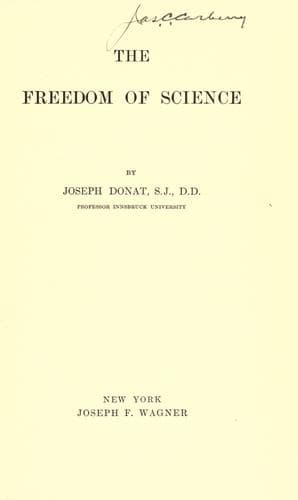
Free thought; Modernism (Christian theology) -- Catholic Church; Religion and science; Teaching, Freedom of
In his diary, “Menschen und Dinge,” 1885 (page 29), _Schoenbein_
writes: “There are still people who fancy in their limited mind
that, the deeper the human intellect penetrates the secrets of
nature, the more extensive its knowledge, the wider its conception
of the exterior world, the more it must forget the cause of all
things. Many have gone even so far as to assert that natural
science must lead to the denial of God. This view is without all
foundation. He, who contemplates with open eyes, daily and hourly,
the doings and workings of nature, will not only believe, but will
actually perceive, and be firmly convinced, that there is not the
smallest place in space where the divine does not reveal itself in
the most magnificent and admirable way.” And in a similar strain
_Liebig_ writes: “Indeed, the greatness and infinite wisdom of the
Creator of the world can be realized only by him who endeavours to
understand His ideas as laid down in that immense book,—nature, in
comparison to which everything that men otherwise know and tell of
Him, appears like empty talk” (Die Chemie in ihrer Anwendung).
Now let us turn to the geographers. We merely mention _Ritter_ (died
1859), the man who raised geography to the dignity of a science; he was a
faithful Protestant, while biassed against the Catholic Church. In spite
of this, a Catholic historian, _J. Janssen_, has sketched his life, in
which we read: “Firm in his belief in the living God, and in the Incarnate
Son of God, His Redeemer, he furnishes a clear and convincing proof that
this faith, far from being a contradiction to natural science ... alone
enables man to acquire an extensive and deep knowledge of nature.” We give
only passing notice to the founder of scientific crystallography, _R.
Hauy_ (died 1822), who was a dutiful Catholic priest. The geologists now
will get a hearing.
Public-domain text, read in full here on John Shaqi.
Reviews
Reviews
No reviews yet
Be the first to share your thoughts on this work.
Elsewhere in the archive
Join the Discussion
Join the discussion
Sign in to leave a comment or review.
Sign InorCreate an account