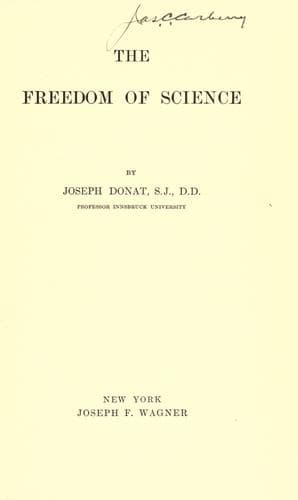
Free thought; Modernism (Christian theology) -- Catholic Church; Religion and science; Teaching, Freedom of
“Alas, how sad was the fate of these poor rebels! The rye soon began to
languish till it lay prone on the ground; green leaves turned yellow, the
flowers drooped, faded and withered. Then the plants began to grumble at
the poplar. There it stood, its leaves a seared yellow. ‘What simpletons
you are, brothers and sisters!’ it said. ‘Can’t you see that now you are
much more like yourselves than under the rule of the Sun? Now you are
refined, independent beings, well rid of the sluggish health of yore.’
There were some who still believed what the poplar said. ‘We are
independent, we are unfettered,’ they clamoured, till the last spark of
life was gone. Not long after the poplar, too, stood there with its
branches bared,—it had died. The farmers, however, complained about the
failing of the crop, and consoled themselves by hoping for better success
the next year.”
A parable of deep meaning! It may serve as an illustration for the facts
stated, and for those yet to be dealt with.
According to the Christian view, man is dependent on his Creator, from
whom he receives life and light, and, in the same way, his mind depends on
truth, by which it lives as the plants live, by the light and the warmth
of the sun. To many generations this was self-evident, and withal they
felt themselves free, because they looked for the freedom only of the
dependent creature. And, keeping within these bounds, they had a cheerful
existence in the happy possession of their faith, contented and serene in
the possession of truth; their higher spiritual life throve and
flourished, promoted by the Eternal Giver of light and warmth, who held
out to them the prospect of completing their mental life in the
contemplation of His eternal truth.
What the fathers deemed self-evident has now become a problem to their
sons. What to their fathers was lofty and revered, the things to which
they ascribed their ennoblement, have become to the sons an obstacle to
free development. They have forgotten what they are. They demand
independence and freest realization of their own individuality, in which
they see the sole source of greatness and progress. In every dependence
they perceive a hampering of their natural development.
We have in previous chapters become acquainted with this _liberal
freedom_, particularly in reasoning and in scientific research, the child
of the philosophy of humanitarianism and subjectivism, the philosophy that
emancipates man from God’s rule, from the immutable religious truths, and
which sees in this emancipation perfect freedom. We have listened to the
arguments in behalf of this position, especially arguments against the
duty to believe. All that we have set forth hitherto was to prove that
such a freedom is not required. In the faithful adherence to God’s
revelation and to His Church there is no degradation of reason, an
exaltation rather; because to join in the eternal reason of its Creator is
not bondage but a privilege.
Public-domain text, read in full here on John Shaqi.
Reviews
Reviews
No reviews yet
Be the first to share your thoughts on this work.
Elsewhere in the archive
Join the Discussion
Join the discussion
Sign in to leave a comment or review.
Sign InorCreate an account