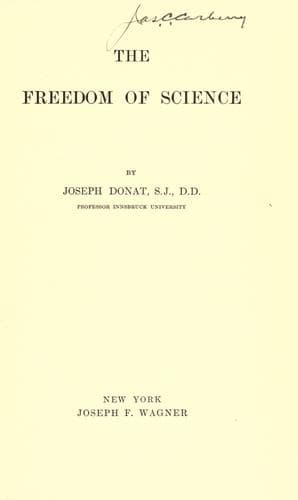
Free thought; Modernism (Christian theology) -- Catholic Church; Religion and science; Teaching, Freedom of
_A. Rambacher_, as he relates in a pamphlet, sent the scientific
treatise on Lourdes by Dr. _Boissarie_ to Prof. _Haeckel_, with
the request to read it, in order to gain a better notion of the
existence of a supernatural world. After some urging he finally
received the following reply, which speaks volumes for the
attitude of the natural scientist towards facts: “With many thanks
I hereby return the book by Dr. _Boissarie_ on the Great Cures of
Lourdes which you sent me. The perusal of the same has convinced
me anew of the tremendous power of superstition (glorified as
‘pious belief’) of naïve credulity (without critical examination),
and of contagious collective suggestion, as well as of the cunning
of the clergy, exploiting them for their gain.... The physicians,
said to testify in behalf of the ‘miracles’ and the supernatural
phenomena, are either ignorant and undiscerning quacks, or
positive frauds in collusion with the priests. The most accurate
description of the gigantic swindle of Lourdes I know of, is that
of _Zola_ in his well-known novel.... With repeated thanks for
your kindness ... _Ernst Haeckel_.” Against all the facts in
evidence this dogmatic scientist was safely intrenched behind the
stone wall of his presumptions. He knew in advance that everything
was superstition or the fraud of cunning priests, that all
physicians who certified to cures were quacks and cheats. _Zola’s_
tendentious romance considered the best historical source! Mention
should be made here how this celebrated novelist dealt with facts
at Lourdes. In the year 1892, the time of the great pilgrimage,
_Zola_ went to Lourdes. He wanted to observe and then tell what he
had seen. An historical novel it was to be; time and again he had
proclaimed in the newspapers that he would tell the whole truth.
At Lourdes all doors were opened to him; he had admittance
anywhere; he could interview and obtain explanations at will. How
he kept his promise to report the truth may be shown by a single
instance: _Marie Lebranchu_ came to Lourdes on August 20, 1892,
suffering from incurable consumption. She was suddenly cured, and
never had a relapse. One year after her cure she returned to the
miraculous Grotto. The excellent condition of her lungs was again
verified. Now, what does _Zola_ make of this event? In his novel
the cured girl suffers a terrible relapse upon her first return
home, “a brutal return of the disease which remained victorious,”
we read in _Zola’s_ book. One day, the president of the Lourdes
Bureau of Investigation introduced himself to _Zola_ in Paris, and
asked him “How dare you let _Marie Lebranchu_ die in your novel;
you know very well that she is alive and just as well as you and
I.” “What do I care,” was _Zola’s_ reply, “I think I have the
Public-domain text, read in full here on John Shaqi.
Reviews
Reviews
No reviews yet
Be the first to share your thoughts on this work.
Elsewhere in the archive
Join the Discussion
Join the discussion
Sign in to leave a comment or review.
Sign InorCreate an account