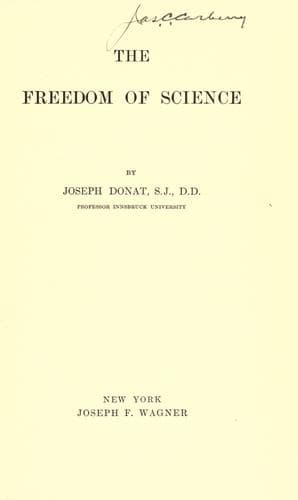
Free thought; Modernism (Christian theology) -- Catholic Church; Religion and science; Teaching, Freedom of
opposing speaker of that evening, subsequently sent word to
_Wasmann_ that: “One can pretty well judge what to think of a
natural scientist who publishes such stuff. For this reason I now
declare that I shall never in future, no matter how or where,
enter into discussion of matters of natural science with Mr.
_Wasmann_.” When on a certain occasion _Hegel_ was advised that
some facts did not agree with his philosophical notions, he
replied: “The more pity for the facts.”
The English natural scientist, _W. Thomson_, once said before the British
Society at Edinburgh: “Science is bound by eternal honour to face
fearlessly every problem that can be clearly laid before it.” The equally
famous _Faraday_, in the name of empirical research, demands of its
adherents the determination to stand or to fall with the results of a
direct appeal to the facts in the first place, and with the strict logical
deductions therefrom in the second. In general these principles are
adhered to so long as religious notions are not encountered. But as soon
as these are sighted, the engine is reversed, and all scientific
principles are forgotten.
A science led by this spirit will set out to emancipate man’s moral
conduct of life from God and religion. Indeed, the first postulate of
modern ethics directs that _morality_ must be _independent of religion_.
That God and eternal salvation is the end of man, the ultimate norm of his
moral life, that God’s Command is the ultimate reason of the moral
obligation, and divine sanction its strongest support, it does not want to
acknowledge. Here, too, we find the principle of natural causality in
operation. “As in physics God’s will must not be made to serve as an
explanation, so likewise in the theory of moral phenomena. Both the
natural and the moral world, as they exist, may point beyond themselves to
something transcendental. But we cannot admit the transcendental ... a
scientific explanation will have to be wholly immanent, and
anthropological” (_Paulsen_). According to this approved principle of
ignoration, the supreme aim and law of a morality without religion is
_man_, his earthly happiness, and his culture.
Public-domain text, read in full here on John Shaqi.
Reviews
Reviews
No reviews yet
Be the first to share your thoughts on this work.
Elsewhere in the archive
Join the Discussion
Join the discussion
Sign in to leave a comment or review.
Sign InorCreate an account