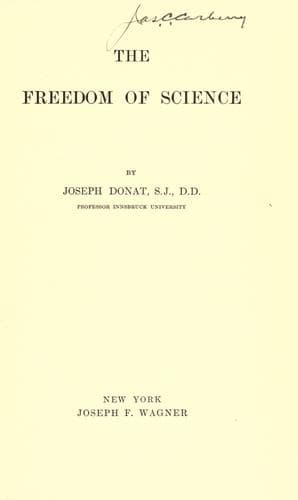
Free thought; Modernism (Christian theology) -- Catholic Church; Religion and science; Teaching, Freedom of
and look in vain for an escape from the wretched labyrinth of doubt.
Chapter II. The Unscientific Method.
The efforts of liberal science, to remove more and more from its scope the
supernatural powers, show clearly that man may feel the truth to be a
yoke, and that he may attempt to free himself from this yoke by opposing
the truth and by substituting postulates for knowledge. Sceptical,
autonomous subjectivism, the philosophy of liberal free thought, has
changed the nature of human reasoning, and its relation to truth, and
perverted it to its very opposite. No longer is the human mind the vassal
of Queen Truth, as _Plutarch_ put it, but the autocratic ruler who
degrades truth to the position of a servant. Thus liberal freedom of
thought becomes the principle of an unscientific method, because it loses,
by false reasoning and false truth, the first condition of solid and
scientific research; furthermore, by treating the highest questions with
consequent levity, it betrays a lack of earnestness which again renders it
unfit for scientific research in serious matters.
False Reasoning.
“The philosophical thinkers of to-day,” says an admirer of _Kant_, _A.
Sabatier_, “may be divided into two classes, the pre-Kantian and those who
have received their initiation and their philosophical baptism from
_Kant’s_ Critic.”
The Christian philosophy of a _St. Thomas_, which is, as even
representatives of modern philosophy are constrained to admit, “a system
carried out with clear perception and great sagacity” (_Paulsen_),
contains many a principle, the intrinsic merit of which will be fully
appreciated only when contrasted with the experiments of modern
philosophy. An instance is the principle of the old school, that cognition
is the likeness of that which is cognized. Apart from the cognition by
sense, we are given here the only correct principle, coinciding with the
general conviction that reasoning is the mental reproduction of an
objective order of existence, independent of us, even in our conception of
the metaphysical world. Thinking does not create its object, but is a
reproduction of it; it is not a producer, but a painter, who copies the
world with his mental brush within himself, sometimes only in the
indistinct outlines of indefinite conception, often, however, in the sharp
lines of clear cognition.
Public-domain text, read in full here on John Shaqi.
Reviews
Reviews
No reviews yet
Be the first to share your thoughts on this work.
Elsewhere in the archive
Join the Discussion
Join the discussion
Sign in to leave a comment or review.
Sign InorCreate an account