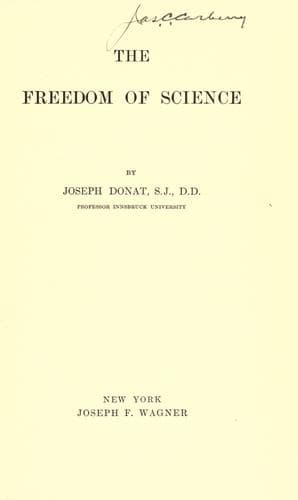
Free thought; Modernism (Christian theology) -- Catholic Church; Religion and science; Teaching, Freedom of
These principles represent the apostasy from objective truth, and, at the
same time, the apostasy from the _principles of true science_: their first
demand, the proper understanding of truth, is perverted into its very
opposite. A necessary quality of scientific research is exactness;
exactness, however, demands most conscientious cleaving to truth; scale
and measure are its instruments. The reverse of exactness is to cast away
scale and measure, to turn eye and ear, not toward reality, but toward
one’s self, so as to observe personal wishes and inclinations, and then
shape the results of the “research” accordingly. This may be a method of
freedom, but it cannot be the method of science. The very thing that true
research would eliminate in the first place, viz., to have the decision
influenced by hobbies and moods, is most important in the method of
individualism; objectiveness, deemed by true science the highest
requirement, is to that method the least one: what true science first of
all insists on, namely, to prove that which is claimed, this method knows
but little of. It recalls the method of the gourmet who selects that which
gratifies his taste: it may be likened to the dandy picking frock-coat and
trousers that suit his whim. True research, with a firm hand at the helm,
aims to direct its craft so as to discover new coasts, or at least a new
island; the exploring done by liberal research is like casting off the
rudder to be tossed by the waves, for its task is only to hold to the
course which the waving billows of individual life give to it. True
science, finally, seeks for serious results, able to withstand criticism:
the research by individualism produces results which, as individualism
itself confesses, must not be taken seriously. They are the subjective
achievements of amateurs, creations of fashion, cut to the pattern of the
ruling principle: _nihil nisi quod modernum est_. A science that professes
such a method is beyond a doubt unfit to play a beneficial part in the
endeavour of mankind.
Do not say: but it is not claimed that religion and view of life are
matters of scientific research: on the contrary, they are always
distinguished from science. It is true, this is not infrequently claimed.
But it is also known how energetically just these matters are appropriated
by science. Is it not exactly this sphere in which free research is to be
active? Is it not its aim to construct a “scientific view of the world,”
as opposed to the Christian belief? Is there not the conviction that
science has already carried much light and enlightenment into this very
sphere, that it has upset the old tenets of faith?
Public-domain text, read in full here on John Shaqi.
Reviews
Reviews
No reviews yet
Be the first to share your thoughts on this work.
Elsewhere in the archive
Join the Discussion
Join the discussion
Sign in to leave a comment or review.
Sign InorCreate an account