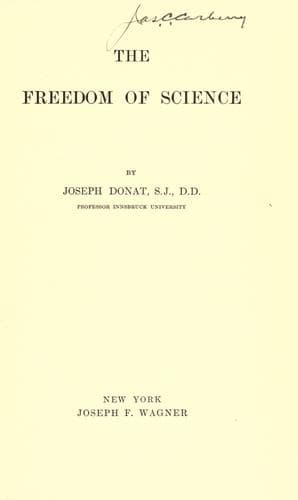
Free thought; Modernism (Christian theology) -- Catholic Church; Religion and science; Teaching, Freedom of
If we read such statement, if, in addition, we remember the
popular-philosophical science of men like _Haeckel_, particularly perhaps
the literature which he recommends for information about Christianity, and
of which he himself makes use; if we have read _Schopenhauer_,
_Nietzsche_, or the “Philosophy of Races” of a _Chamberlain_,—we can no
longer be at a loss what to think of the “rule of reason” and of the
“search for pure truth.” Observe, also, the restless haste of those who,
having turned their back upon the Catholic Church, now proceed to attack
her, observe their agitated work and incitement, how they rummage and
ransack the nooks and corners of the history of the Church in quest of
refuse and filth, and if the find is not sufficient how they even help it
along by forgery, all this to demonstrate to the world that the grandest
fact in history is really absurdity and filth;—then one will understand
what instincts may be found there to guide “reason and science.” How even
sexual impulses are trying to shape their own ethics we shall not examine
here. _F. W. Foerster_ relates: “I once heard a moral pervert expound his
ethical and religious notions; they were nothing but the reflection of his
perverse impulses. But he thought them to be the result of his reasoning.”
Is there not known in these days the inherited disorder of the human heart
as characterized by the Apostle in the words: “But I see another law in my
members, fighting against the law of my mind, and captivating me in the
law of sin (Rom. vii. 23)”? The Ancients knew it. The wisdom of _Plato_
knew it, who speaks of the “pricks of sin, sunk into man, coming from an
old, unexpiated offence, giving birth to wickedness.” The wise _Cicero_
knew of it: “Nature has bestowed upon us but a few sparks of knowledge,
which, corrupted by bad habits and errors, we soon extinguish, with the
result that the light of nature does nowhere appear in its clearness and
brightness.” Truth is often disagreeable to nature. And if not subdued and
ruled by strong discipline, nature proceeds to oppose the truth. Only to
lofty self-discipline and purity of morals is reserved the privilege of
facing the highest truths with a calm eye. “Blessed are the pure in heart,
for they shall see God.”
Mental Bondage.
Public-domain text, read in full here on John Shaqi.
Reviews
Reviews
No reviews yet
Be the first to share your thoughts on this work.
Elsewhere in the archive
Join the Discussion
Join the discussion
Sign in to leave a comment or review.
Sign InorCreate an account