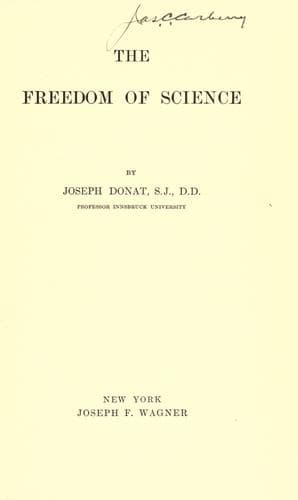
Free thought; Modernism (Christian theology) -- Catholic Church; Religion and science; Teaching, Freedom of
Recognizing this fact, man will try to rise above himself, to cleave to a
superior Power and Wisdom, who, in purer heights, untouched by human
passions, holds aloft the truth, in order to rise thereby above his own
bondage; he will understand the necessity of an authority clothed with
divine power and dignity, so that it may hold in unvanquished hands the
ideal against all onslaughts of human passions. He will without difficulty
find this power in the religion of Jesus Christ and in His Church: in Him,
who could not be accused of sin, who by His Cross has achieved the highest
triumph over flesh and sin, who has surrounded His Church with the bright
throng of saints. And if he sees this religion and Church an object of
persecution, he will behold in it the signature of its truth. For truth is
a yoke despised by sensualism and pride, and the spiritual power that
contends for purity and truth will be hated.
Without Earnestness.
The regrettable conception of truth proper to the modern freedom of
thought, leads to that flippancy with which our time is prone to treat the
highest questions. Why conscientiousness and anxious care? All that is
needed is to form one’s personal views; there is no certain, generally
valid, truth in religious matters. Hence there is often in this sphere of
scientific research a method wholly different from that in use anywhere
else. In history, philology, natural science, there is a striving for
exactness, but in these matters exact reasoning is replaced only too often
by discretionary reasoning, by loose forming of ideas; in the very domain
which has ever pre-eminently been called the province of the wisdom of
life, there is now in vogue the method of flippancy.
True wisdom is convinced that reason has not been given to man to grope in
the dark in respect to the most momentous questions of life; that reason,
though limited and liable to err, is given him to find the truth. True
wisdom knows its difficulties when the matter in quest is metaphysical
truth: it knows how, in this case, more than in any other, reason is
exposed to the influence of inclinations from within, and to the power of
error and of public opinion from without; that in these matters, least of
all, reason is not in the habit of taking the truth by assault. True,
there are intuitions, and inspiration by genius—they have their rights,
but they are the exceptions. The ordinary, and only safe, way is to
advance cautiously, by discoursive thinking, from cognition to cognition,
otherwise there is danger of a sudden fall from the steep path.
Public-domain text, read in full here on John Shaqi.
Reviews
Reviews
No reviews yet
Be the first to share your thoughts on this work.
Elsewhere in the archive
Join the Discussion
Join the discussion
Sign in to leave a comment or review.
Sign InorCreate an account