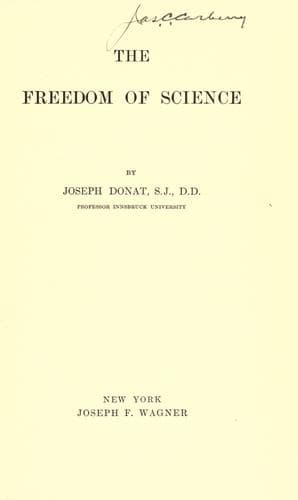
Free thought; Modernism (Christian theology) -- Catholic Church; Religion and science; Teaching, Freedom of
While still a pagan, but moved by his desire for truth, the philosopher
_Justin_ went to the schools of his day to seek the solution of his doubts
and queries. First he turned to a Stoic, but as he taught nothing of God,
_Justin_ was unsatisfied. He next went to a Peripatetic teacher, then to a
Pythagorean, but failed to find what he desired. The Platonist at last
gave him something. Walking alone along the beach, and musing over
_Plato’s_ principles, he met an old man who referred him to the truth of
Christianity, to the Prophets and the Apostles: “They alone have seen the
truth and proclaimed it unto man, they were afraid of no one, knew no
fear; yielded to no opinion; filled with the Holy Ghost, they spoke only
what they saw and heard. The Scriptures are still extant, and he who takes
them up will find in them a treasure of information about principles and
ultimate things, and all else the philosopher must know, if he believes
them.”(14) And _Justin_ found truth and peace, and bowed to the yoke of
the doctrine of Jesus Christ.
What a striking contrast between this serious love of truth in the days of
passing heathendom, and the uncontrolled thinking of so many in our
Christian age! To them truth is no longer a sacred treasure, a yoke to be
assumed in reverence; it has become the plaything of their impressions and
inclinations. Indeed, they consider it a burden to accept the old
Christian truth, with which they meet on all their ways.
Chapter III. The Bitter Fruit.
The Vocation of Science.
Science is, and ever was, an influential factor operating upon the
thought, aims, and actions of man. Hence science must remain conscious of
its vocation. First of all it is to hold aloft and preserve the _spiritual
possessions of mankind_. True, science must also progress; but progress
means growth, which presupposes the preservation of what has been received
from of old. This applies pre-eminently to the philosophical-religious
patrimony of the past; no error could be more fatal than to presume that
each generation must start from the beginning, that the foundations, which
have safely supported human life for centuries, must be obsolete because
human nature is suddenly considered changed.
Public-domain text, read in full here on John Shaqi.
Reviews
Reviews
No reviews yet
Be the first to share your thoughts on this work.
Elsewhere in the archive
Join the Discussion
Join the discussion
Sign in to leave a comment or review.
Sign InorCreate an account