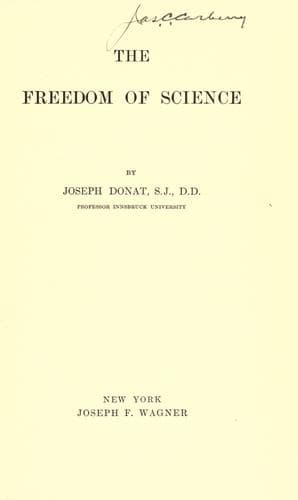
Free thought; Modernism (Christian theology) -- Catholic Church; Religion and science; Teaching, Freedom of
Thus again the Vatican Council defines clearly: “To enable us to
do our duty in embracing the true faith and remaining in it
steadfastly, God has through His incarnate Son established the
Church and set plain marks upon His institution, in order that it
may be recognized by all as the guardian and interpreter of
revelation. For only the Catholic Church possesses all those
arrangements, so various and wonderful, made by God in order to
demonstrate publicly the credibility of Christianity. Indeed the
Church of itself, because of its wonderful propagation, its
pre-eminent sanctity and inexhaustible fecundity in everything
good, its Catholic unity and invincible duration, is a grand
permanent proof of its credibility and irrefutable testimony in
behalf of its divine mission. Thus, like a ’standard unto the
nations,’ it invites those to come to it who have not yet
believed, and assures its children that the faith they profess
rests upon a most firm foundation.”
The Catholic looks with pride upon his Church: she has stood all
the trials of history. He sees her endure, though within harassed
by heresies and endangered by various unworthiness and incapacity
of her priests, and attacked incessantly from without by
irreconcilable enemies, yet prevailing victoriously through the
centuries, blessing, converting nations and beloved by them; while
by her side worldly kingdoms, supported by armies and weapons, go
down into the grave of human instability. The most wonderful fact
in the world’s history, contrary to all laws of natural,
historical events,—here a higher hand is plainly thrust into human
history; it is the fulfilment of the divine promise: “I am with
you all days, even to the consummation of the world.” “The gates
of hell shall not prevail against it.” He sees the Saints, who
have lived in this Church and have become saints through her,
those superhuman heroes of virtue, who far surpass the laws of
human capacity.
Public-domain text, read in full here on John Shaqi.
Reviews
Reviews
No reviews yet
Be the first to share your thoughts on this work.
Elsewhere in the archive
Join the Discussion
Join the discussion
Sign in to leave a comment or review.
Sign InorCreate an account