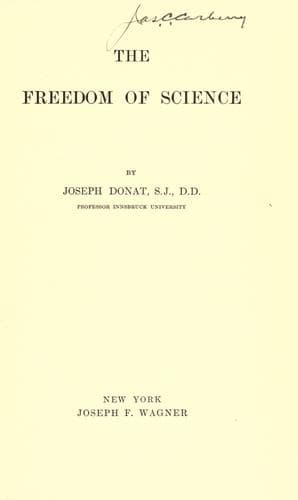
Free thought; Modernism (Christian theology) -- Catholic Church; Religion and science; Teaching, Freedom of
In the most widely different states of life in the Church he sees
virtue grow in the degree in which one submits to her guidance. He
witnesses the remarkable spectacle, that everything noble and good
is attracted by the Church, and their contrary repelled. He sees
the miracles which never cease in her midst. Finally he beholds
her admirable unity and vigorous faith; she alone holding firm to
her teaching, not compromising with any error; she alone holding
fearlessly aloft the principle of divine authority, and thus
becoming a beacon to many who are seeking a safe shelter from
spiritual ruin. In addition we finally have that harmony and
grandeur of the truths of faith, and—perhaps not in the last
place—that calm and peace of mind, produced in the faithful soul
by a life led according to this faith, by prayer and the reception
of the Sacraments. This is a clear proof that where the Spirit of
God breathes there cannot be the seat of untruth.
These are sufficient proofs to produce even in the uneducated, and in
children, true and reasonable certainty, provided they have had sufficient
instruction in religion. It must, however, be emphasized that this
conviction produced by faith need _not first be gained by scientific
investigation_ of the motives of faith, or by minute or extensive
theological studies. A wrong notion of human knowledge frequently leads to
the opinion that there is no true certainty at all unless it is the result
of scientific study—a presumption on which is based the claim of freedom
of science to disregard any conviction, be it ever so sacred, and the
claim that it is reserved to science alone to attain the sure possession
of the truth. Later on we shall dwell more at length upon this important
point. Let it suffice here to remark that the intellect can attain real
certainty even without scientific research; most of our convictions, which
we all hold unhesitatingly as true, are of this kind. They constitute a
belief that is based upon the real knowledge of the reason, which
knowledge is not, however, so clear and distinct that it could be
demonstrated easily in scientific form.
The certainty of faith, therefore, is based upon the knowledge that God
Himself vouches for the truth of the teachings of faith. This relieves the
faithful from the necessity of obtaining by his own reflection an insight
into the intrinsic reasons of the why and the wherefore of the proposed
truth, and to examine in each instance the correctness of the thing. He
knows that God has revealed it, that His infallible Church vouches for it;
hence it is credible and true; that suffices for him, just as trustworthy
evidence suffices for the historian concerning facts which he himself has
not observed.
Public-domain text, read in full here on John Shaqi.
Reviews
Reviews
No reviews yet
Be the first to share your thoughts on this work.
Elsewhere in the archive
Join the Discussion
Join the discussion
Sign in to leave a comment or review.
Sign InorCreate an account