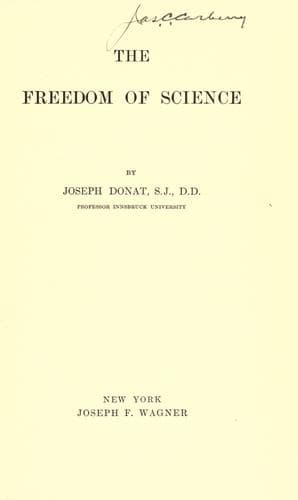
Free thought; Modernism (Christian theology) -- Catholic Church; Religion and science; Teaching, Freedom of
Any one who shares such ideas about the supernaturalness of the
Catholic Church has, of course, forfeited his claim to understand
Catholic life and faith. The Catholic believes in his Church, not
on any account of Asiatic patriarchs and superstitious
dignitaries, but because she is led by the Holy Ghost, and the
Pope must believe the same as the humblest of the faithful:
neither the Pope himself relies upon his own judgment, nor does
the Catholic who trusts in the word of the Pope.
We add a few remarks which may further illustrate the action of
faith.
The knowledge of the fact of revelation, hence of the credibility
of the truths revealed, is certain, as shown above. Nevertheless,
_it does not compel_ reason to assent. Under ordinary
circumstances it would be impossible to think of one’s own
existence, of the elementary laws of mathematics, without being
constrained by the evidence to give direct internal assent. But
insight into the truth of a thing is not always of this high
degree of clearness. In such cases it is an empirical law of the
mind that reason discerns of itself the _logical_ necessity, that
is, if it desires to proceed according to the merits of the case,
without, however, acting under _physical_ constraint. There
remains then the determination, the command of the will. This is
generally true of many judgments about natural things, but
especially true of belief. The knowledge of the fact of revelation
is true and certain, though it might be still clearer. The truths
offered by divine revelation are too deep for us to comprehend
them fully; they imply questions and difficulties for us to
ponder. We feel the physical possibility of pondering these
difficulties, although we see at the same time that the difficulty
is exploded by the certainty of the fact of revelation; but we
remain _free_ in giving our assent.
Herein lies the possibility of _meritorious_ faith, the
possibility of the creature rendering to God the free tribute of
his free submission. At the same time it opens the possibility of
turning voluntarily to doubts, and of submitting to them more and
more, till the mind becomes clouded and ensnared by error. Thus,
since faith depends on free will, the will is strictly commanded
to impel the intellect to assent and cling to faith and to put
aside doubts. God has revealed the truths of faith that they may
be firmly believed.
Public-domain text, read in full here on John Shaqi.
Reviews
Reviews
No reviews yet
Be the first to share your thoughts on this work.
Elsewhere in the archive
Join the Discussion
Join the discussion
Sign in to leave a comment or review.
Sign InorCreate an account