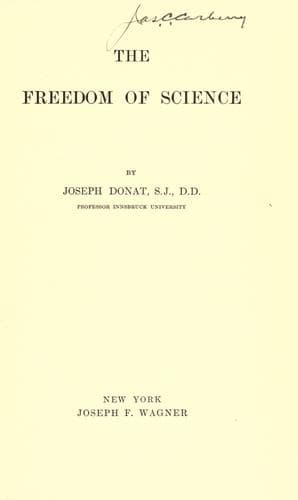
Free thought; Modernism (Christian theology) -- Catholic Church; Religion and science; Teaching, Freedom of
What, then, does the duty to believe require of the faithful Christian? He
is required, first of all, to assure himself of the certain credibility of
those truths which he is required to believe, and here authentic proofs
are offered him. On his perception of the credibility of these truths, he
ought to assent to and accept God’s testimony. Hence there should be no
coercion to believe without interior conviction, no obstacle put in the
way of recognizing the truth. _Where, then, is here any opposition to the
lawful freedom of research_, to the right of unimpeded search for the
truth? How is reason hindered in its search for the truth when truth is
offered it by an infallible authority? We have here no opposition to the
laws of reason, but due honour to its sacred rights; no bondage, but
elevation and enrichment, completion and crowning of its thought, for the
highest truth has been communicated to the reason that it may be of one
mind with that Infinite Wisdom which has shaped reason for the truth, and
from which it obtains its light as the planet from the sun around which it
revolves.
Therefore, it cannot be said that “the Catholic resolves to believe as
true what the Church teaches in the Apostles’ Creed, but were he offered
anything else as Church doctrine he would accept it as well. Hence these
doctrines do not express his own personal opinions, they are something
extraneous to him.” (_W. Herrmann_, Roemische u. evangelische
Sittlichkeit, 3d ed., 1903, p. 3). No, what the Catholic, what any true
Christian, believes by faith, that is his innermost conviction, as it is
the firm conviction of the historian that what he has drawn from reliable
sources is true.—But what if the contrary were offered him? Well, this
assumption is absurd; and why? Because God and His Church are infallible,
and an infallible authority cannot speak the truth and its contrary at the
same time. Much less than a reliable historical witness can testify to the
truth and its contrary at the same time.
This same conviction gives to the faithful Christian the firm assurance
that no certain result of human research will ever come in conflict with
his faith, just as the mathematician does not fear that his principle will
ever be contradicted by any further work. Truth can never contradict
truth. “Thus we believe and thus we teach and herein lies our salvation.”
It is the very old conviction of the faithful Christian “that philosophy,
that is, the study of wisdom, and religion are not different things.” _Non
aliam esse philosophiam, i.e., sapientiae studium et aliam religionem_
(_Augustinus_, De Vera Religione, 5). It is precisely this that enables
the believing scientist to devote himself with great freedom and
impartiality to research in every field, and to acknowledge any certified
result without fear of ever having to stop before a definite conclusion.
Public-domain text, read in full here on John Shaqi.
Reviews
Reviews
No reviews yet
Be the first to share your thoughts on this work.
Elsewhere in the archive
Join the Discussion
Join the discussion
Sign in to leave a comment or review.
Sign InorCreate an account