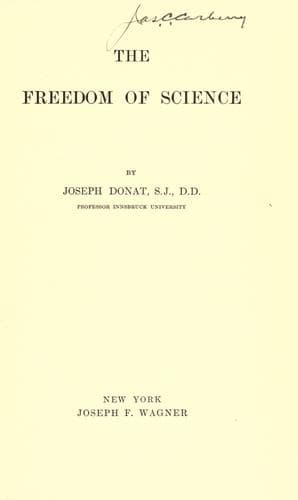
Free thought; Modernism (Christian theology) -- Catholic Church; Religion and science; Teaching, Freedom of
Nevertheless, such narrow-mindedness is strongly to be censured. It has
often caused the reproach, that Catholics lack the freedom to admit
scientific discoveries. They forget the wise admonition of the prince of
mediæval theologians, that it were advisable, in regard to scientific
views which have nothing to do with religion, neither to set them down as
truths of faith, nor either to reject them as contrary to faith lest
occasion be given to think contemptuously of the faith. As long as men are
and men think, narrow-mindedness will never be lacking. Hence if the
believing scientist wants to know whether he is running counter to faith
in any particular, he has to ascertain from theological text-books what
the Church declares to belong to faith, what explanation of Holy Scripture
is unconditionally binding, and not what is the individual opinion of
theologians, much less what some pious nurse is telling the little ones.
This is the first rule concerning the relation between faith and science:
it states what the scientist is _not_ tied down to.
2. Science Retains its Method of Research.
But when and how may the scientist be restricted? Here we come to the
second point: the directions which faith may give to the profane sciences
are in themselves not of a positive but of a _negative kind_; revelation
and Church cannot tell the scientist what he is to assert or defend in the
field of the profane sciences, but only what propositions he must _avoid_.
Thus every science is left free to pursue its own method of research. It
is not difficult to understand this.
Faith draws from divine revelation; profane sciences, as such, do not draw
from divine revelation, but only from experience and reason. Philosophy
would cease to be philosophy and become theology did it demonstrate the
immortality of the soul by revelation. The anthropologist would cease to
be an anthropologist and become a theologian if he would attempt to prove
the common origin of mankind by Holy Scripture.
In other words, the profane sciences are distinguished from faith and
theology by their formal object, by the end they have in view, by the
scientific method with which they handle their subject. Theology, of
course, uses revelation extensively; and in this it differs from the other
sciences. Hence faith cannot command the anthropologist to defend also in
profane science the common origin of the human race from Adam and Eve,
because it is held to be a revealed truth. He must say: I believe as a
Christian that this is true, established by divine revelation, and no
science will ever prove the contrary; but whether I can positively defend
this fact as resulting from anthropology, depends on my ability to
corroborate it by the methods of this science, that is by the testimony of
profane history. And just as little could the historian be required to
obtain historical results of which he cannot produce the evidence
according to his method.
Public-domain text, read in full here on John Shaqi.
Reviews
Reviews
No reviews yet
Be the first to share your thoughts on this work.
Elsewhere in the archive
Join the Discussion
Join the discussion
Sign in to leave a comment or review.
Sign InorCreate an account