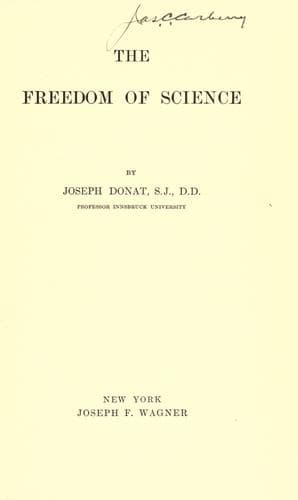
Free thought; Modernism (Christian theology) -- Catholic Church; Religion and science; Teaching, Freedom of
Ghost, who will seldom tolerate error. He is promised to the teaching
Church for the safe guidance of the faithful; these declarations are,
however, the ordinary doctrinal utterances of that ecclesiastical office.
And the Holy Ghost cannot permit that the teaching authority should by a
wrong decision forfeit the confidence it enjoys.
Moreover, this authority ranks very high even when looked at from a purely
human standpoint. Those who are invested with it are mostly men of great
learning, competent to give such doctrinal decisions by virtue of their
experience and position, and learned advisers are at their side. They are
guided by the tradition and wisdom of a universal Church, which measures
its history by thousands of years: the decisions, too, are for the most
part but the application or repetition of previous doctrinal utterances.
Besides, there is the hesitating caution which advances to a decision only
after long deliberations, and in undemonstrated matters usually refrains
from decision; a caution which has increased still more in recent times,
since so many subtle questions have arisen on the boundaries of science
and faith. It is also known that many inquisitive eyes are constantly
turned on Rome, and a single wrong decision might entail most disagreeable
consequences for friend and foe. The pressure must be very great before a
much-disputed question is taken up at all.
Of course it is by no means impossible that difficulties may pile up in
such a way that an error may really be made. History knows of such a case.
But the very fact that the one case of _Galileo_ is always quoted, and,
therefore, that in the long history of the Congregations this is
considered to be almost the only case of importance, is a proof how
carefully the Congregations proceed, and that supernatural aid is granted
them. An institution which in the course of its long existence had to
reply to innumerable questions and against which only one wrong decision
of importance can be pointed out, must necessarily be an exemplary
institution. An institution so free from human error must surely be guided
by the Holy Ghost. Compare with this the many cases in which science has
had to correct itself, had to abandon its long-championed propositions as
untenable.
Public-domain text, read in full here on John Shaqi.
Reviews
Reviews
No reviews yet
Be the first to share your thoughts on this work.
Elsewhere in the archive
Join the Discussion
Join the discussion
Sign in to leave a comment or review.
Sign InorCreate an account