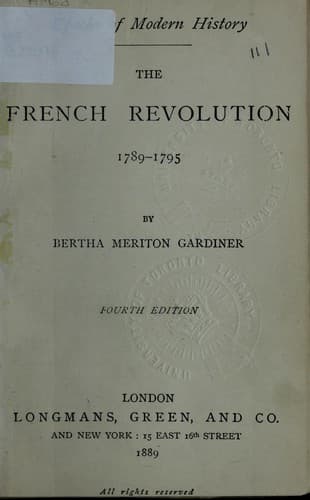
The French Revolution 1789-1795Gardiner, Bertha Meriton
History
The French Revolution 1789-1795
Gardiner, Bertha Meriton
France -- History -- Revolution, 1789-1799
The Jacobins openly proposed to depose the King. Those who shared
their views in the Assembly, however, consisted of but a small body
of members, who were called the Mountain, because they occupied the
topmost benches on the left. Unhappily the majority refused to take
into consideration a question the solution of which in the sense
indicated by the Jacobins would have spared much future misery to
both King and people. In the house of Roland, the dismissed Girondist
minister of the interior, projects were discussed of defending the
line of the Loire in case of the Allies reaching the capital. Madame
Roland, a talented, enthusiastic woman, who directed the actions of her
husband, was the centre of a small, and uncompromising circle, which
was ready to abet the destruction of the throne by violence. But the
leading Girondists--Vergniaud, Brissot, Guadet, and Gensonné--unwilling
that the republic should owe its origin to violence, were prepared to
give support to the throne had Louis assented to make the executive
dependent on the Legislature, and to restore the late ministers to
office. Their overtures to this effect were, however, rejected; and,
meanwhile, a second insurrection, which had for its object the King’s
deposition, was in preparation. The Assembly, after declaring the
country in danger, had authorised the sections of Paris, as well
as the administrative authorities throughout France, to meet at
any moment. The sections had, in consequence, been able to render
themselves entirely independent of the municipality. In each of the
sectional or primary assemblies from 700 to 3,000 active citizens had
the right to vote, but few cared to attend, and thus it constantly
happened that a small active minority spoke and acted in the name
of an apathetic constitutional majority. Thousands of volunteers
passed through Paris on their way to the frontier, some of whom were
purposely retained to take part in the insurrection. The municipality
of Marseilles, at the request of Barbaroux, a young friend of the
Rolands, sent up a band of 500 men, who first sung in Paris the verses
celebrated as the ‘Marseillaise.’ The danger was the greater since
every section had its own cannon and a special body of cannoneers, who
nearly to a man were on the side of the revolutionists. The terrified
and oscillating Assembly made no attempt to suppress agitation,
but acquitted (August 8) Lafayette, by 406 against 280 votes, of a
charge of treason made against him by the left, on the ground that
he had sought to intimidate the Legislature. This vote was regarded
as tantamount to a refusal to pass sentence of deposition on Louis.
On the following night the insurrection began. Its centre was in the
Faubourg of St. Antoine, and it was organised by but a small number
of men. Mandat, the commander-in-chief of the national guard, was an
energetic constitutionalist, who had taken well concerted measures
for the defence of the Tuileries. But the unscrupulousness of the
Public-domain text, read in full here on John Shaqi.
Reviews
Reviews
No reviews yet
Be the first to share your thoughts on this work.
Elsewhere in the archive
Join the Discussion
Join the discussion
Sign in to leave a comment or review.
Sign InorCreate an account