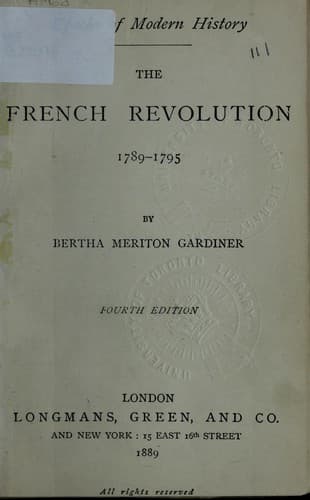
The French Revolution 1789-1795Gardiner, Bertha Meriton
History
The French Revolution 1789-1795
Gardiner, Bertha Meriton
France -- History -- Revolution, 1789-1799
Dumouriez’ treachery increased the violence of the party struggle at
Paris, where Girondists and Montagnards strove to cast on each other
the odium of being the traitor’s accomplices. It was against Danton
that the Girondists directed their most vehement attacks. They made
charges in support of which they had no evidence to bring, and which
have never been proved. According to them Danton had been bribed by
Louis; he had misapplied public money; in Belgium he had plundered
state property. They even accused him of plotting with Dumouriez the
restoration of the throne, because he had praised that general’s
talent in the Convention. Danton turned fiercely on his assailants,
threatening irreconcilable war. Counter accusations and menaces
were hurled from right to left, from left to right. Robespierre
came forward to represent the entire public life of the Girondists
as forming a long series of crimes directed against liberty and the
republic, and concluded with a formal proposal to send Brissot,
Vergniaud, Gensonné and Guadet, along with Marie Antoinette and the
Duke of Orleans, as Dumouriez’ accomplices, before the new criminal
court (April 9).
♦Committee of Public Safety.♦
Though the ascendancy which the Girondists once held was lost, their
eloquence was still a power, and the first deputy who was sent before
the court was a Montagnard, Marat, on the charge of inciting the people
to insurrection (April 14). But this isolated party victory served only
to irritate without weakening their adversaries. The court, composed
of judges and jurymen, both elected in Paris, acquitted the accused,
and his partisans restored him in triumph to his seat. The direction
of the government, possessed by the Girondists at the opening of the
convention, passed into other hands. The ministry had been broken
up. Roland had resigned, complaining that he had not the support of
the Convention. The Mountain and the Gironde struggled to obtain
appointments for their own candidates, and the ministers, fearful of
having their acts misinterpreted, refused to take a step on their
own responsibility. Hence the wheels of government, when expedition
and secrecy were most requisite, threatened to come to a standstill.
Under the influence of the alarm excited by the treason of Dumouriez,
the Convention established a Committee of Public Safety, composed of
nine members, but subsequently enlarged to twelve, who were subject to
re-election every month, and were empowered to deliberate in secret,
to superintend the action of the ministry, and to take provisionally
whatever measures were requisite for the national defence (April 6).
The deputies entrusted with these large powers were Danton and eight
others belonging to the Mountain and the Plain. From this time the
ministers sank into the position of chief clerks of their respective
departments, while the Committee of Public Safety stood at the head of
the executive government.
♦Committee of General Security.♦
Public-domain text, read in full here on John Shaqi.
Reviews
Reviews
No reviews yet
Be the first to share your thoughts on this work.
Elsewhere in the archive
Join the Discussion
Join the discussion
Sign in to leave a comment or review.
Sign InorCreate an account