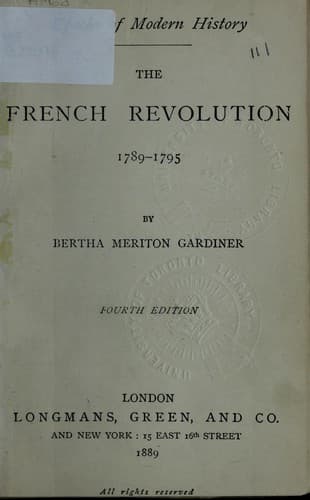
The French Revolution 1789-1795Gardiner, Bertha Meriton
History
The French Revolution 1789-1795
Gardiner, Bertha Meriton
France -- History -- Revolution, 1789-1799
Though in the departments there was no popular movement in favour of
the Girondists, yet they had more supporters there than in the capital.
In Paris all authorities, with the exception of the Convention, were
on the side of the conspirators. In the departments the administrative
bodies, which had all been re-elected since the autumn, resembled
closely in constitution the Convention itself. As a rule, in these
bodies supporters of the Girondists were in a majority, supporters
of the Mountain in a minority. In more than sixty departments
administrative bodies contested the authority of the Convention, and
threatened to resort to arms in favour of the expelled deputies. The
chief centres of resistance were, in the north-west, Rennes and Caen;
in the south-west, Bordeaux. The danger of a general insurrection
seemed greater, owing to the fact that royalists at the same time
were raising the standard of revolt. In the important industrial town
of Lyons they gained the entire direction of affairs. The leaders
of the Jacobins were put to death, and active preparations were
taken to resist by force the authority of the Convention. At Toulon
like dispositions were manifested and the same course was pursued.
In the departments of Ardéche and Lozère royalist conspirators had
already been in arms before the expulsion of the Girondists; while
in La Vendée and Deux Sèvres the peasants since March were in open
rebellion. The task, however, of quelling resistance under these
circumstances was, in reality, less formidable than at first sight
appeared. There could be no alliance between royalist and Girondist
insurgents, and the mere fact that royalists were in arms increased
the reluctance of the population to dispute the authority of the
mutilated Convention. Hence the opposition raised by the supporters
of the Girondists was vacillating and weak. The administrative bodies
could not rely on any class for hearty support. Even amongst the
proscribed deputies themselves union was wanting. While some fled to
Normandy, others remained in Paris, prepared to suffer whatever fate
awaited them rather than bring upon themselves the guilt of exciting
civil war. On the other side, the party victorious in Paris was for
the time thoroughly united, and acted with caution and decision. The
Committee of Public Safety, under Danton’s guidance, sought to pursue
a policy of conciliation, and the supporters of the Commune, aware of
the insecurity of their position, held themselves under restraint.
The charge of socialism and tyranny made by the Girondists was
repudiated by the adoption of a new constitution, based upon individual
liberty and democratic principles. There was indeed not the smallest
intention of putting this constitution in force, but its promulgation
held out promise to the country of a speedy return to normal modes
of government. The phrase ‘The Republic, one and indivisible,’ was
adopted by the Montagnards to signify the national cause, while they
Public-domain text, read in full here on John Shaqi.
Reviews
Reviews
No reviews yet
Be the first to share your thoughts on this work.
Elsewhere in the archive
Join the Discussion
Join the discussion
Sign in to leave a comment or review.
Sign InorCreate an account