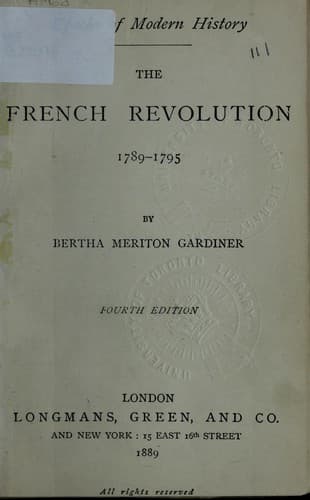
The French Revolution 1789-1795Gardiner, Bertha Meriton
History
The French Revolution 1789-1795
Gardiner, Bertha Meriton
France -- History -- Revolution, 1789-1799
The cry uttered by the murdered man was heard, and Charlotte, who did
not attempt to escape, was captured and conveyed to prison amid the
murmurs of an angry crowd. It had been from the first her intention to
sacrifice her life for the cause of her country, and glorying in her
deed, she met death with stoical indifference. ‘I killed one man,’ she
said, when brought before the revolutionary court, ‘in order to save
the lives of 100,000 others.’
♦Sanguinary tendencies of the Government.♦
Thus perished by the hands of an assassin the man who, since the
revolution began, had persistently maintained that assassination was
a justifiable mode for the accomplishment of political ends. His
murder brought about contrary results to those which the woman who
ignorantly and rashly had flung away her life, hoped by the sacrifice
to effect. Marat had not been the creator of the circumstances which
enabled him to exert influence, and there was no lack of men equally
sanguinary, and equally fanatic, ready to usurp the place left vacant
by his death. He was regarded as a martyr by no small portion of the
working population of Paris. The influence which he had exerted over
them was in reality due, not so much to his exhortations to massacre,
as to the fact that amongst the many writers who had put themselves
forward as the spokesmen of the lower orders, he alone had truly at
heart the destruction of the existing material misery. His murder
excited indignation beyond the comparatively narrow circle of those
who took an active part in political life, while at the same time it
added a new impulse to the growing cry for blood. After the expulsion
of the Girondists, power drifted more and more into the hands of those
who were most violent in language, and who were prepared to be most
violent in act. The more moderate section of the Mountain, composed of
Dantonists and seceders from the Plain, rapidly lost influence. They
were without means by which to exert control over their colleagues,
and were driven to use exaggerated and sanguinary language in order
to escape the charge of being themselves bad patriots and secret
supporters of royalists and federalists. The deputies forming the right
and centre of the Convention kept silence, or ceased to appear in their
seats. The nation remained passive, incapable of resistance. Every day
the Government displayed a more and more ferocious character. It was
cruel, because it was weak in the sense that it had little material
force on which it could rely for support, if its authority were once
disputed. It was cruel also, because it was resolute and fanatic,
determined to maintain itself at whatever cost, and at the same time
under the influence of theories and ideas which could not be carried
into practice except by resort to despotic means and by the destruction
of individual as well as of political liberty.
♦Disorganisation of Government.♦
Public-domain text, read in full here on John Shaqi.
Reviews
Reviews
No reviews yet
Be the first to share your thoughts on this work.
Elsewhere in the archive
Join the Discussion
Join the discussion
Sign in to leave a comment or review.
Sign InorCreate an account