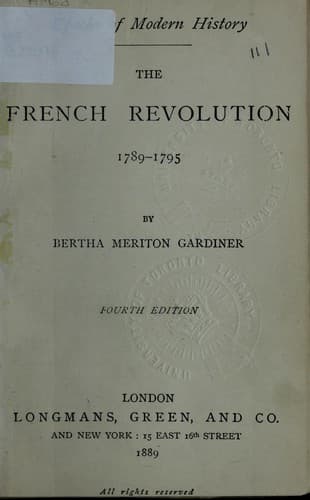
The French Revolution 1789-1795Gardiner, Bertha Meriton
History
The French Revolution 1789-1795
Gardiner, Bertha Meriton
France -- History -- Revolution, 1789-1799
The people, said Chaumette, shall be our God; we need
no other. We want, said Hébert, no other religion than that of nature;
no other temple than that of reason; no other worship than that of
liberty, equality, and fraternity. By the orders of the Commune the
suppression of the Catholic worship was begun. Constitutional priests
were encouraged to marry and to abdicate their functions, and those who
refused were imprisoned. The exercise of the Catholic worship, either
in the streets or in the churches, was prohibited. Even burial rites
were changed. Every sign of mourning was abolished, and the black pall
was replaced by a tricolour cloth.
These things were done by the Commune on its sole authority, but the
Convention offered no opposition. The voices of Catholics were silent
through fear. Forty bishops and curés had seats in the House. But of
these the bravest had been proscribed with the Girondists. If few
deputies professed atheism, those who were theists and sceptics saw
not without gratification the suppression of the Catholic worship
by other hands than their own. Urged on by the Commune the Assembly
adopted a new calendar, which was in reality incompatible with the
maintenance of the Catholic Church as a State institution. The year
was divided into twelve months of thirty days each and five odd days;
each of the months into three weeks of ten days each. The months
were named after the seasons, the Frosty, the Rainy, and the like.
The year I. began on September 22, 1792, the day of the proclamation
of the republic. Hostility towards Catholicism was yet more plainly
evinced by the adoption of a new law, which treated the constitutional
clergy as enemies of the revolution. Not only were nonjurors to be
immediately transported to the West Coast of Africa, and if taken
in hiding in France to be put to death, but constitutional priests
were made subject to transportation to the same place at the pleasure
of the administrative authorities. Willingly or unwillingly the
Convention was dragged in the wake of the Commune, and had to give
official recognition to the new worship. Gobel, the Archbishop of
Paris, attended by his chaplains and curés, was brought before the
Assembly to make public resignation of his office. Several bishops
and curés, who were deputies, rose and followed his example. One man
alone, a Montagnard, Grégoire, the constitutional Bishop of Blois had
the courage to protest and to declare his intention of maintaining his
post (November 7). From day to day revellers, masquerading in priestly
vestments and laden with church plate, visited the Convention, there
to deposit their spoils and to denounce as impostors the maintainers
of Catholic doctrines. Finally, a festival in honour of Reason was
celebrated in the Church of Notre Dame. A mountain of painted wood was
erected in the choir, on which was seated a woman representing Reason,
dressed in white, with a pike in her hand and a red cap on her head.
Public-domain text, read in full here on John Shaqi.
Reviews
Reviews
No reviews yet
Be the first to share your thoughts on this work.
Elsewhere in the archive
Join the Discussion
Join the discussion
Sign in to leave a comment or review.
Sign InorCreate an account