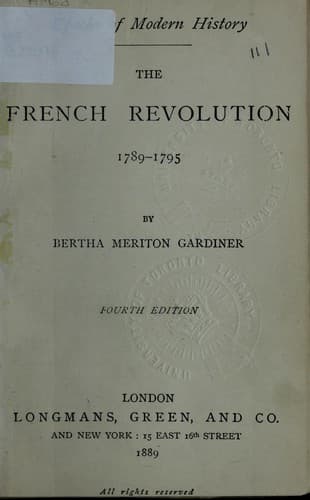
The French Revolution 1789-1795Gardiner, Bertha Meriton
History
The French Revolution 1789-1795
Gardiner, Bertha Meriton
France -- History -- Revolution, 1789-1799
of food, the fugitives made their way to Normandy, in the hope of
occupying Granville, a port town, and of receiving aid from England.
But they had no siege pieces, and their repeated attempts to storm the
fortifications failed. Then despair, long since felt by the chiefs,
overtook the whole body. The ranks of the fighting men, incessantly
called on to repel the attacks of the pursuing enemy, were gradually
thinned; there was dearth of food, and the sufferings of the wounded
were intense. The republicans massacred every man, woman, and child
left behind. The peasants forced their officers to lead them back to
their own country. Angers was reached, where was a bridge over the
Loire. But their attempt to force an entrance into the town failed. A
defeat took place outside Le Mans (December 12); the retreat became
a flight. Thousands were killed and made prisoners; a few escaped in
boats; the rest were hunted down and slaughtered on the banks of the
Loire.
♦The Terror in the departments.♦
While this civil war was continuing in the west, scenes similar to
those occurring in Paris occurred simultaneously throughout the
country. The will of the Commune was law in most of the departments of
France. Some of the deputies in mission joined the Hébertist faction,
and their colleagues followed in their train, not daring to venture
collision with them. Men, in fact, adopted the language then in vogue,
and acted cruelly, instigated by fear lest if they showed clemency
they would offer a handle which their enemies would use to compass the
ruin of themselves and their families. The deputies in mission, so
long as they found protection in Paris, exercised uncontrolled powers
over the properties and lives of their fellow-citizens. They imposed
fines and taxes, set aside laws, created criminal offences, and erected
criminal courts. Many decrees of the Convention merely extended to the
whole country measures already in force in different departments. As
instruments the deputies had at their service the municipalities, which
were reconstituted over and over again; the clubs, from which they
drove all who were not prepared slavishly to applaud their actions;
and, finally, the revolutionary committees, to which they delegated
the same arbitrary powers that they themselves exercised. These
committees, of which there was one established in every district and
every populous commune, were, as a rule, formed of the most fanatic,
the most cowardly, and the most worthless men whom the neighbourhood
produced. Many thousand persons were at their bidding flung into prison
on the merest pretext or without any motive at all being given. One
would be imprisoned because he was related to an emigrant, another
because he was a fanatic, a third because he was an egotist, a fourth
because he had done nothing for the revolution, a fifth because he had
100_l._ or 50_l._ a year. Persons of both sexes, of every age and rank,
were involved in the same proscription.
Public-domain text, read in full here on John Shaqi.
Reviews
Reviews
No reviews yet
Be the first to share your thoughts on this work.
Elsewhere in the archive
Join the Discussion
Join the discussion
Sign in to leave a comment or review.
Sign InorCreate an account