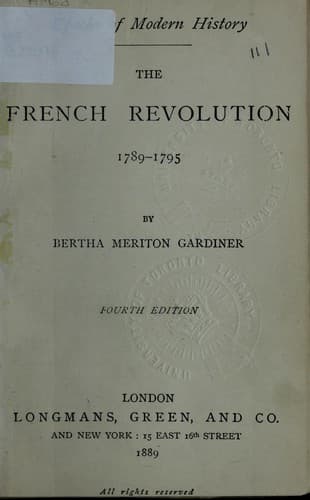
The French Revolution 1789-1795Gardiner, Bertha Meriton
History
The French Revolution 1789-1795
Gardiner, Bertha Meriton
France -- History -- Revolution, 1789-1799
Neither deputies in mission nor administrative officers attempted
to arrest the assassins or to bring them to justice. The Convention
expressed indignation, but took no active measures for the maintenance
of law and order. In fact, men still lived in incessant fear of a
revival of the Terror, and hence for the time they regarded with
indifference the reaction in the south, in spite of its Royalist
tendencies. After the insurrection of Germinal, the condition of the
people at Paris remained unchanged. The rations of bread on occasions
fell as low as a couple of ounces. Jacobins and other agents of
the Terror did their utmost to direct the ever-swelling flood of
discontent against the Convention. On May 20, or Prairial 1, a second
insurrection broke out, fiercer, more extended, and more persistent
than the preceding one. The insurgents, men and women, broke into
the Convention clamouring for bread, and insulting and reproaching
the deputies without distinction of party. With cries for bread were
joined cries for the Constitution of 1793, but the crowd was without
leaders, and barely knew its own ends, still less by what means to
seek their realisation. On the arrival of battalions of the national
guard in support of the Convention, a general combat took place
within the Chamber, in which the defenders of the Convention were at
first worsted. A deputy, Feraud, who sought to protect the President,
Boissy d’Anglas, from insult, was wounded by the populace and dragged
outside, his head cut off and paraded on a pike through the streets.
Many deputies fled. A few Montagnards, threatened by the mob and urged
by the frightened deputies on the right, put to the vote the demands
raised by voices in the crowd, such as the release of imprisoned
patriots and the reconstitution of the Committees of Government. The
insurgents, who were now appeased, began to disperse, when more
national guards arrived and drove away those who still remained.
Victory, however, was not secured. The Faubourg St. Antoine remained
in insurrection, and the next day directed the mouths of its cannon
upon the Tuileries. The Convention only secured its safety by promising
to provide bread, and to put in force the Constitution of 1793. In
the meantime, however, 4,000 troops of the line were being brought to
Paris. These, with a selected force of national guards, surrounded
the insurgent faubourg. To a population supported upon rations, there
was no choice between yielding or starving. They yielded, giving up
arms and cannon (May 23). The Convention made use of its triumph to
destroy the Mountain and to secure itself against a repetition of the
late scenes. A decree for the disarmament of agents of the Terror
furnished a pretext for taking pikes and guns from the hands of the
people, and the national guard was reorganised so as to exclude from
active service the poorer sections of the population. Many hundred
persons were imprisoned. The revolutionary court had already been
dissolved.
Public-domain text, read in full here on John Shaqi.
Reviews
Reviews
No reviews yet
Be the first to share your thoughts on this work.
Elsewhere in the archive
Join the Discussion
Join the discussion
Sign in to leave a comment or review.
Sign InorCreate an account