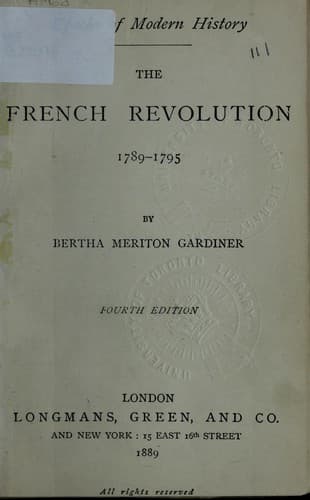
The French Revolution 1789-1795Gardiner, Bertha Meriton
History
The French Revolution 1789-1795
Gardiner, Bertha Meriton
France -- History -- Revolution, 1789-1799
As yet Austria had, during the course of the war, made no territorial
acquisition. In the second division of Poland, Russia and Prussia
alone shared. The chancellor, Thugut, the director of Austrian foreign
policy, and the one statesman of mark whom Austria possessed, was
a continuator of the schemes formerly entertained by Joseph II.
for the extension and consolidation of the Austrian dominions. He
possessed the entire confidence of his master, Francis II., but the
position which he held was isolated, and his authority limited. Had
he attempted to draw upon the resources of the various kingdoms and
duchies subject to the Emperor, as the Convention had drawn upon the
resources of France, he would have incited disturbance and revolt on
every side. The administration, more especially of the war department,
was inefficient and lax, and the public service suffered in consequence
of the negligence or wilfulness of officials high in place. Thugut was
the son of a poor boatbuilder, and the court nobility never forgot his
origin, and thwarted him on every opportunity. Thugut, however, proud,
despotic, and ambitious, would not be diverted from his course by
misfortune in war, by the factious opposition of a court nobility, or
by the ill-will and discontent of subject populations. On the retention
of Belgium he laid no great stress. Belgium lay far from the seat of
government, and though wealthy, its wealth was not at the arbitrary
disposition of the Emperor. If, however, he were to resign Belgium,
Thugut required an ample equivalent for the loss elsewhere, and before
bringing to a close the French war, designed further to acquire an
indemnity equal to that which Prussia had obtained by the second
partition of Poland. There were three courses by which Thugut saw
possible opportunities of making acquisitions. He might make Austrian
influence supreme in Germany by the annexation of Bavaria, or he might
extend the Austrian dominions in Italy, or, again, he might acquire new
possessions in the East, at the expense of Poland and of the Porte.
For the time he had no thought of entering into negotiation with the
Republic, because he expected best to gain his ends by making common
cause with England and Russia, which two Powers were both urgent for
the continuation of the war.
♦Alliances between Austria and Russia.♦
Public-domain text, read in full here on John Shaqi.
Reviews
Reviews
No reviews yet
Be the first to share your thoughts on this work.
Elsewhere in the archive
Join the Discussion
Join the discussion
Sign in to leave a comment or review.
Sign InorCreate an account