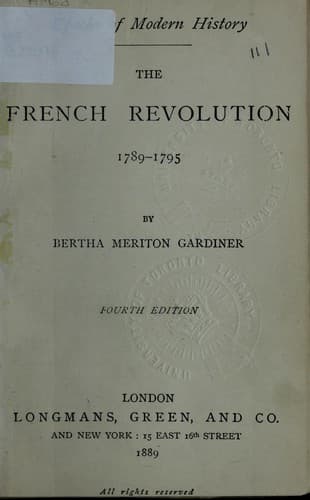
The French Revolution 1789-1795Gardiner, Bertha Meriton
History
The French Revolution 1789-1795
Gardiner, Bertha Meriton
France -- History -- Revolution, 1789-1799
Between France and England the strong sense of national hostility
which existed when the war first broke out had increased in intensity.
There was no name so hated in France as the name of Pitt. The English
statesman, who by his gold sustained the arms of the Coalition, had
also, according to popular report, by his bribes and emissaries been
the author of the Terror, and was held responsible for all the internal
ills under which France suffered. In England, the feeling of hatred
was fully reciprocated. The ideas of the Revolution were regarded
with abhorrence, the Convention with loathing, and the triumph of
the French armies did but excite the stronger determination to go on
fighting until both Holland and Belgium were wrested from the grasp
of the atheistic and regicide Republic. If England had ignominiously
been beaten on the Continent, she had been victorious at sea. Corsica
had been occupied, and George III. proclaimed (February, 1794). A
naval battle had been fought, commonly called the battle of June 1,
when the French fleet, sailing out of Brest, had been defeated by
Lord Howe, and driven back shattered to the coast (1794). Tobago, St.
Martinique, Guadaloupe, and other French West Indian islands were
already in English possession, and St. Domingo, the most important of
French colonies, threatened with conquest. If now the Dutch fleet was
pressed into the service of France, on the other hand the rich Dutch
colonies, possessions coveted by England, such as Ceylon and the Cape,
were open to seizure. The Cabinet was indeed intensely eager that the
Continental war should continue, and was making every exertion to fan
the zeal of Austria, and to draw Russia on to render active assistance.
Instead of subsidising Prussia, England now subsidised Austria. In
return for a loan of 4,600,000_l._ the Emperor undertook to put 200,000
men in the field (May 4, 1795). A treaty was, at the same time, entered
into between England and Russia, in which Catherine agreed to send
12,000 men to fight against France. Subsequently, in the autumn, a
Triple Alliance was concluded between the three Powers, and separate
negotiations renounced (September 28).
♦Treaty of Basel.♦
Public-domain text, read in full here on John Shaqi.
Reviews
Reviews
No reviews yet
Be the first to share your thoughts on this work.
Elsewhere in the archive
Join the Discussion
Join the discussion
Sign in to leave a comment or review.
Sign InorCreate an account